



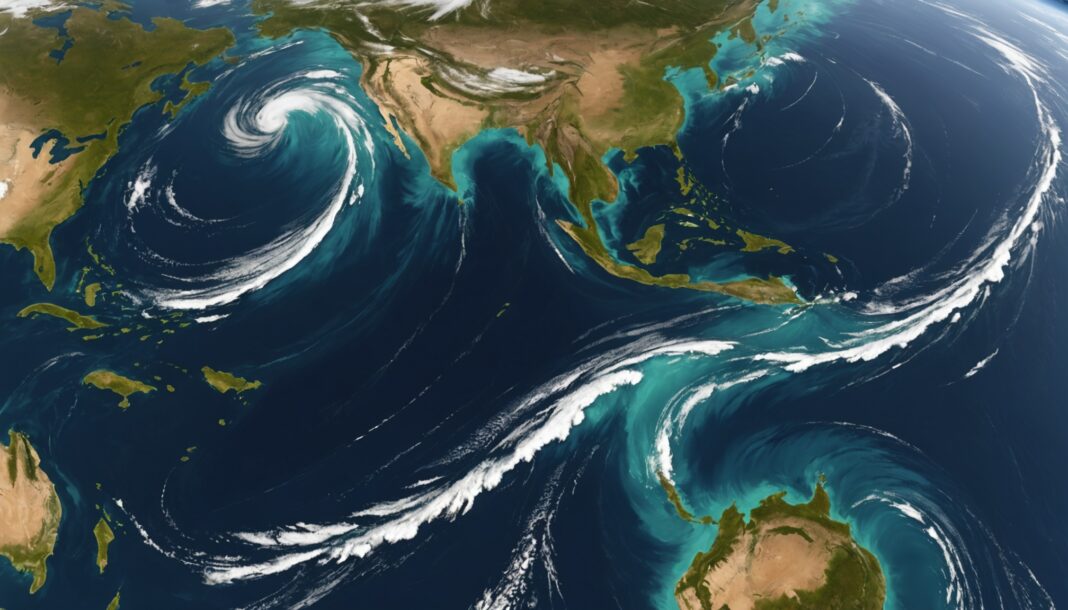

World's major meteorological centers are unanimous: an exceptional El Niño episode is forming in the Pacific, and it could break every record observed since modern measurements began in 1950. According to the American agency NOAA and the World Meteorological Organization (WMO), the probability that the phenomenon will reach the “very strong” category by the end of the year now exceeds 90%.
A Signal That Surpasses Everything Ever Measured
El Niño is a periodic warming of surface waters in the central and eastern equatorial Pacific, which disrupts atmospheric currents and alters rainfall and temperature patterns across several continents. According to NOAA's latest projections, the temperature anomaly could approach 3.5°C at the peak of the event, between October and December. Combining forecasts from fourteen independent modeling groups, 96% of simulations point to an episode more intense than any recorded since the mid-20th century.
Another indicator closely monitored by climatologists: the probability that the phenomenon will continue through spring 2027 is now estimated at 97%. According to the WMO, an episode this long and this intense has never been documented with such statistical certainty at this point in the year.
Delayed Effects, Felt Mostly in 2027
Contrary to popular belief, El Niño's effect on global temperatures is not felt immediately: it typically occurs with a lag of several months. In practical terms, this means the peak warming linked to this episode could be felt not this year, but in 2027, which could then become the hottest year ever recorded worldwide—surpassing records already broken during previous episodes.
The expected consequences vary significantly by region: increased droughts in the Amazon, Australia, and southern Africa, heavier rainfall in parts of South America, and milder, wetter winters in Western Europe. In France, the scenarios discussed by meteorologists point to a winter that is generally milder than normal, but with an increased risk of intense rainfall events.
Why This Phenomenon Concerns Everyone
El Niño is not just a climate curiosity: it directly affects agriculture, fishing, water availability, and even global food prices, by disrupting harvests in several major production regions. Insurers and risk managers are also closely monitoring its evolution, since past episodes have been linked to costly natural disasters (floods, droughts, wildfires).
In response to this signal, the WMO is calling on governments to prepare now: strengthening early warning systems, adapting agricultural policies, and increasing monitoring of water resources in the most exposed regions. The next model updates, expected in the fall, will help refine these projections as the episode develops.
To keep up with major international climate issues, check out our articles in the Ecology and Climate section, as well as related scientific developments in Science and Technology. Possible repercussions in France can be followed in our Local and National News section.
Frequently Asked Questions
What exactly is El Niño?
It is a periodic, natural warming of surface waters in the equatorial Pacific, which alters atmospheric currents and disrupts rainfall and temperature patterns across several continents.
When will this El Niño episode be at its most intense?
According to NOAA, the peak is expected between October and December 2026, but the effects on global temperatures will mainly be felt in 2027, with a lag of several months.
Will France be affected?
Yes, although the impacts there are generally more moderate than in South America or Oceania: meteorologists anticipate a milder-than-normal winter, with an increased risk of intense rainfall events.
Sources:
World Meteorological Organization (WMO) —
Reporterre —
Tameteo

2026 Commonwealth Games: In Glasgow, a Bet on a Leaner Model to Save Mega Sporting Events
Starting July 23, 2026, Glasgow is hosting an edition unlike any other. The 2026 Commonwealth Games run through August 2 in the Scottish metropolis with an unprecedented ambition: to prove that a major global sporting event can survive while costing…

Asteroids: China and Japan Pull Off a Double Space Feat Three Days Apart
The first week of July 2026 will be remembered as a rare moment in space exploration: three days apart, two Asian probes successfully rendezvoused with some of the smallest asteroids ever approached. The Chinese probe Tianwen-2 settled in near Kamoʻoalewa,…

International Criminal Court: Chad Joins the African Exodus
On July 27, 2026, N'Djamena officially announced its withdrawal from the Rome Statute, the founding treaty of the International Criminal Court (ICC). Chad thus becomes the fourth African country to walk away from the Hague-based court since 2025, following Burkina…

Why a $50 Million T-Rex Fossil Has Scientists Worried
A Tyrannosaurus rex skeleton has just shattered every record on the fossil market. Sold for $50.1 million at an auction in New York, this specimen nicknamed “Gus” is now the most expensive dinosaur bone ever sold at auction — and…
The UN Adopts a New World Map to Turn the Page on Mercator
On September 4, 2026, the United Nations General Assembly adopted an unprecedented resolution: encouraging governments, schools, and major technology companies to gradually phase out the famous world map in the Mercator projection, considered too distorting, in favor of a representation…

PISA: Gap Between Advantaged and Disadvantaged Students Widens in France
On September 8, the OECD released the results of its PISA 2025 survey, conducted among more than 760,000 15-year-old students in 91 countries and regions. In France, the findings go beyond a simple drop in the rankings: it is above…

A Saudi-Funded Dragon Ball Theme Park Near Paris
A Dragon Ball theme park is set to rise about thirty kilometers from Paris. The announcement was officially made on August 24, 2026 by the Élysée, during the visit to France of Saudi Crown Prince Mohammed bin Salman. The project,…

Ebola in the Democratic Republic of Congo: Unprecedented Clinical Trial to Test New Vaccine
A turning point may be emerging in the fight against one of the worst Ebola outbreaks ever recorded. On October 23, 2026, in Bunia, in the Ituri province in the northeast of the Democratic Republic of the Congo (DRC), the…
This article was written with the help of artificial intelligence. Editorial policy