






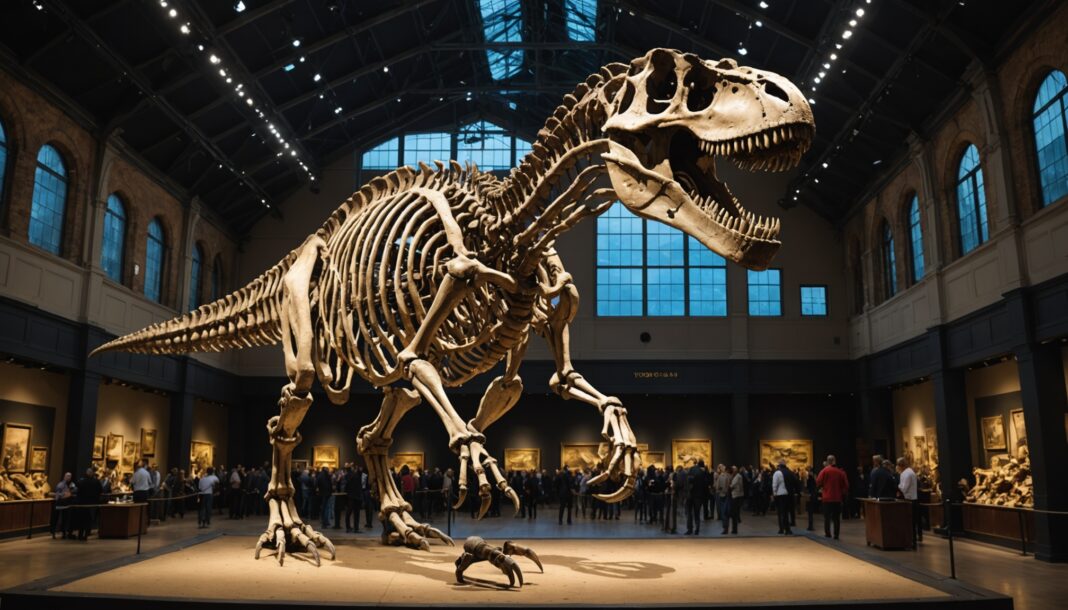

A Tyrannosaurus rex skeleton has just shattered every record on the fossil market. Sold for $50.1 million at an auction in New York, this specimen nicknamed “Gus” is now the most expensive dinosaur bone ever sold at auction — and in the process has reignited a fierce debate among paleontologists.
A Dinosaur Sold Far Beyond Its Estimate
Discovered in 2021 on a ranch in South Dakota, the fossil owes its nickname to Gary “Gus” Licking, the owner of the land where it was unearthed. The skeleton measures roughly 38 feet (11.6 meters) long and nearly 12.5 feet (3.80 meters) tall, and is made up of 183 individual bones, making it one of the most complete T-Rex specimens ever found.
Estimated at between $20 million and $30 million before the sale, Gus ultimately sparked a ten-minute bidding war among seven buyers before being claimed by an anonymous buyer. The previous record belonged to “Apex,” a Stegosaurus skeleton that sold for $44.6 million in 2024 at the same auction house, purchased by an American financier.
Why This Price Worries Scientists
Beyond the staggering figure, it's the fossil's final destination that raises concerns. Once sold to a private buyer, a skeleton of this magnitude can disappear entirely from scientific research and public view, since there's no requirement to display or study it. Several paleontologists have voiced their concern: every exceptional fossil that vanishes into a private collection represents a potential loss of data for science, particularly for the study of growth, anatomy, or behavior in large theropods.
- Skeleton discovered in 2021 on private property in South Dakota
- 183 assembled bones, roughly 38 feet long and 12.5 feet tall
- Sold for $50.1 million, far above its initial estimate
- New record for the most expensive dinosaur fossil ever auctioned
This phenomenon isn't an isolated case: the value of major dinosaur skeletons has been climbing steadily in recent years, as buyers from the investment world increasingly treat these pieces as rare assets, much like art or collectibles.
Museums vs. Private Collectors
Major auction houses, for their part, defend the value of these sales, which sometimes help fund excavations or research and shine a spotlight on paleontology for the general public. But tension with museum institutions remains real: most natural history museums simply can't compete financially with private buyers for this kind of exceptional specimen, which pushes them to focus on fossils that are less spectacular but more accessible for academic research.
The precedent set by “Sue,” a T-Rex that has been on display for decades at the Field Museum in Chicago after also being sold at auction in the 1990s, shows that a privately owned fossil can still end up accessible to the public — but there's no guarantee that will be the case for Gus, whose buyer has not yet been identified.
Frequently Asked Questions
Why did Gus's fossil reach such a high price?
Its size, exceptional state of preservation (183 bones), and the rarity of T-Rex specimens this complete explain the bidding war, which far exceeded the initial estimate.
Will the fossil be visible to the public?
There's no indication of that for now: the buyer remained anonymous, and nothing requires a private owner to display or lend a fossil to a museum.
Is this the most expensive dinosaur fossil ever sold?
Yes, as of now: Gus surpasses the previous record held by the Stegosaurus skeleton “Apex,” which sold for $44.6 million in 2024.
Sources

PISA: Gap Between Advantaged and Disadvantaged Students Widens in France
On September 8, the OECD released the results of its PISA 2025 survey, conducted among more than 760,000 15-year-old students in 91 countries and regions. In France, the findings go beyond a simple drop in the rankings: it is above…

Record Heat: July 2026 Confirmed Among the Hottest Months Ever Measured
Data from the European Copernicus service has just confirmed it: July 2026 ranks among the hottest months ever recorded worldwide since modern measurements began in 1850. The oceans, for their part, broke an all-time record for surface temperature. Beyond the…

Ebola in the Democratic Republic of Congo: Unprecedented Clinical Trial to Test New Vaccine
A turning point may be emerging in the fight against one of the worst Ebola outbreaks ever recorded. On October 23, 2026, in Bunia, in the Ituri province in the northeast of the Democratic Republic of the Congo (DRC), the…

2026 Commonwealth Games: In Glasgow, a Bet on a Leaner Model to Save Mega Sporting Events
Starting July 23, 2026, Glasgow is hosting an edition unlike any other. The 2026 Commonwealth Games run through August 2 in the Scottish metropolis with an unprecedented ambition: to prove that a major global sporting event can survive while costing…

Autonomous Delivery Robots: France Paves the Way on Its Roads
A text published in the Journal officiel (France's official gazette) on August 7, 2026 changes the game for last-mile delivery in France. The Ministry of Transport now authorizes the homologation of autonomous delivery robots capable of traveling on the roadway,…

Olive Oil: Why Spain Is Voluntarily Pulling 188,000 Tons Off the Market
Spanish olive oil is going through an unprecedented episode: rather than letting prices collapse under the weight of an exceptional harvest, the government has chosen to voluntarily pull part of the production off the market. Since November 6, mills across…

Record Heat in Spain: A Signal That Worries Climate Scientists
A new heat record has just been set in Spain. On Thursday, the Spanish weather agency Aemet recorded 45.7°C in El Granado, in western Andalusia — a figure that matches the previous record for the month of September, set in…

Victorian Solar Storm: A Nearly Two-Century-Old Mystery Finally Solved
A train departing sixteen minutes late, a telegraph going haywire on its own, and a century and a half later, scientists reopening the case: this is the story, as quiet as it is fascinating, of a Victorian solar storm whose…
This article was written with the help of artificial intelligence. Editorial policy