





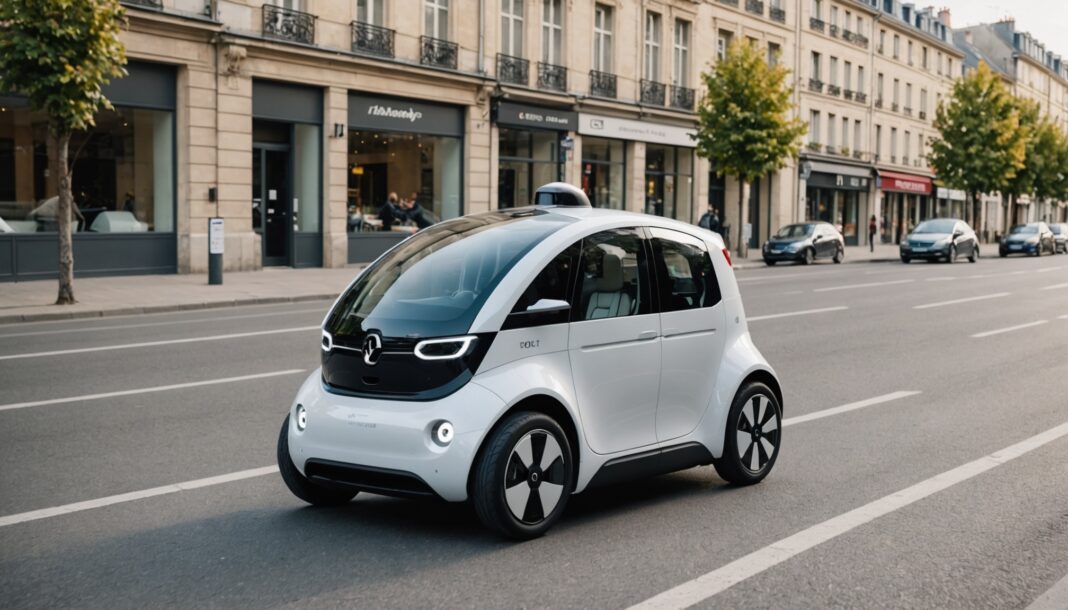

A text published in the Journal officiel (France's official gazette) on August 7, 2026 changes the game for last-mile delivery in France. The Ministry of Transport now authorizes the homologation of autonomous delivery robots capable of traveling on the roadway, off sidewalks. A regulatory shift that paves the way for a new generation of driverless vehicles on French streets.
A New Regulatory Status for These Devices
Specifically, the order dated July 28, 2026 and published on August 7 amends the approval rules for so-called “category L” vehicles, a family that until now included motorcycles, tricycles, and motorized quadricycles. Electric delivery robots, without a driver, up to 4 meters long and capable of carrying up to 1,000 kilograms of goods, can now be included in this category. This classification allows them to be homologated and then put into service on public roads, provided they stay on the roadway: sidewalks, however, remain off-limits to them.
On the technical side, these vehicles are equipped with cameras, radar, and perception software capable of identifying obstacles and controlling the robot's actuators in real time. But autonomy isn't total: each robot must remain under the remote supervision of an operator, responsible for monitoring its progress and intervening if there's a problem.
Local Authorities Keep Control
The text doesn't give manufacturers a nationwide blank check. It's up to municipalities and inter-municipal authorities to determine, on a case-by-case basis, the areas and routes where these robots will be allowed to operate. The government's stated goal is to tailor authorizations to local realities: traffic density, street layout, and uses specific to each area. A tourist town and a suburban logistics zone won't necessarily have the same rules.
For local businesses and players in retail and shopping, this development could, in the long run, reduce short-distance delivery costs and ease the busiest time slots, particularly in dense urban areas. Retailers that were already testing these robots on sidewalks under limited conditions now have a clearer regulatory horizon for scaling up.
A Delivery Industry Asking Questions
This opening isn't unanimously welcomed by every player in the industry. Traditional delivery workers, especially those operating on two or three wheels in major cities, are closely watching the rise of these autonomous devices, which could eventually take over some of the short trips currently handled by humans. France, for its part, says it wants to position itself as one of the very first countries in the world to establish a legal framework for homologating this type of vehicle, putting it ahead of several European neighbors still at the experimental stage.
For companies in the digital and logistics sector, this legal framework is a strong signal: it finally sets stable rules to build business models on, whereas legal uncertainty had until now held back large-scale deployment. It remains to be seen how many French cities will agree, in the coming months, to open their streets to these new arrivals from the high-tech world.
Frequently Asked Questions
Can these robots travel on sidewalks?
No. The order of August 7, 2026 only authorizes them on the roadway, the same as category L vehicles; sidewalks remain reserved for pedestrians.
Is a human operator still required?
Yes. Each robot must remain under the remote supervision of an operator responsible for monitoring its progress and intervening if something unexpected happens, since autonomy isn't total.
Who decides where these robots can travel?
Municipalities and inter-municipal authorities define the authorized areas and routes, based on traffic and street layout. For any question regarding law and regulation, these local decisions are what apply.
Sources

UNESCO World Heritage: In Busan, 30 Sites in the Running and Two French Hopefuls
It's a quiet but decisive gathering for humanity's memory. From July 20 through July 29, 2026, the city of Busan, South Korea, is hosting the 48th session of the Committee for UNESCO World Heritage. It's a first for the country,…

Panama Canal: Drought Forces Drastic Cut to Shipping Traffic
The Panama Canal will reduce its shipping traffic starting September 3, in the midst of a drought driven by the El Niño climate phenomenon. The canal authority (ACP) confirmed on Thursday that the number of ships allowed to transit each…

Jellyfish in the Channel: Why the Gravelines Nuclear Plant Had to Shut Down Its Reactors
The weekend of August 8-10, 2026 once again highlighted a little-known vulnerability of France's nuclear fleet: the proliferation of jellyfish in the English Channel. At the Gravelines nuclear plant in northern France, three reactors had to be shut down and…

Why a $50 Million T-Rex Fossil Has Scientists Worried
A Tyrannosaurus rex skeleton has just shattered every record on the fossil market. Sold for $50.1 million at an auction in New York, this specimen nicknamed “Gus” is now the most expensive dinosaur bone ever sold at auction — and…

Asteroids: China and Japan Pull Off a Double Space Feat Three Days Apart
The first week of July 2026 will be remembered as a rare moment in space exploration: three days apart, two Asian probes successfully rendezvoused with some of the smallest asteroids ever approached. The Chinese probe Tianwen-2 settled in near Kamoʻoalewa,…

Norway: Why the New King Will Never Be Crowned
A page is turning in Scandinavia. Following the death of King Harald V of Norway, which occurred on August 28 at Rikshospitalet hospital in Oslo, his son automatically succeeds him on the throne under the name Haakon VIII. But contrary…

PISA: Gap Between Advantaged and Disadvantaged Students Widens in France
On September 8, the OECD released the results of its PISA 2025 survey, conducted among more than 760,000 15-year-old students in 91 countries and regions. In France, the findings go beyond a simple drop in the rankings: it is above…

A €9 Million Gold Treasure Discovered in the Wall of a Belgian Cellar
A €9 million gold treasure has just been uncovered in the wall of a cellar in Belgium. Coins, bars, and nuggets: the discovery, made by an 18-year-old worker in the middle of plumbing work, is the stuff of dreams. But…
This article was written with the help of artificial intelligence. Editorial policy