






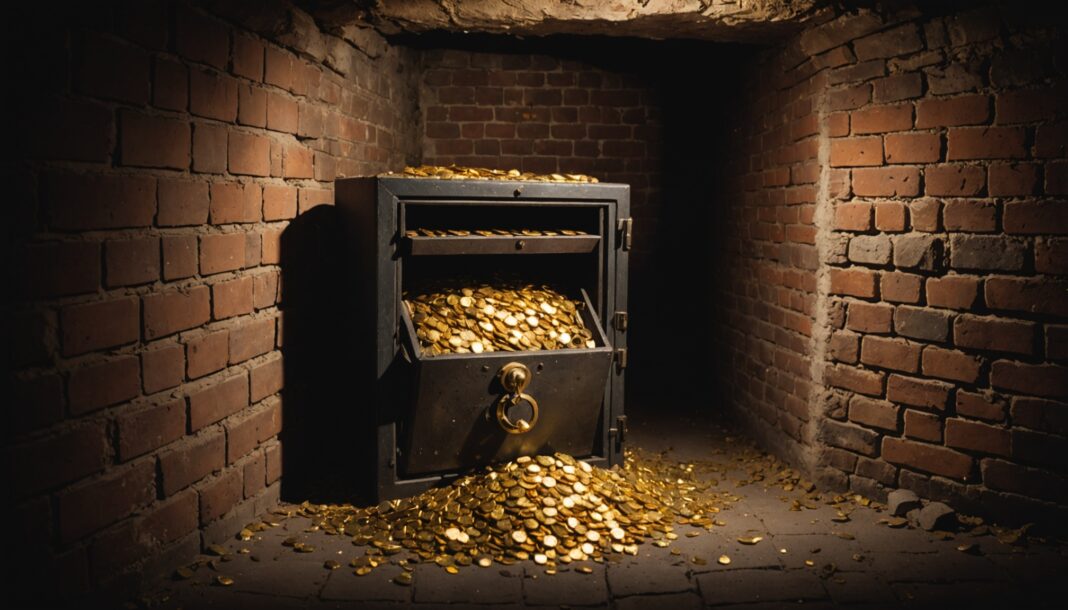

A €9 million gold treasure has just been uncovered in the wall of a cellar in Belgium. Coins, bars, and nuggets: the discovery, made by an 18-year-old worker in the middle of plumbing work, is the stuff of dreams. But behind this spectacular story lies a much more down-to-earth question: who legally owns a treasure that has been sealed away and forgotten for who knows how long?
A Discovery Worthy of a Movie
It all began in the cellars of the former Brouwershuis brewery, in Sint-Gillis-Dendermonde, in East Flanders, Belgium. A construction crew was drilling into the floor to install new drainage pipes when a young intern stumbled upon a chest hidden inside a wall. Inside: coins, numbered bars, and gold nuggets, estimated to be worth more than €9 million. The workers, initially thinking they'd found ordinary one-euro coins, quickly realized the scale of the find and alerted their client, then the police.
The building is now owned by CAW Oost-Vlaanderen, a Belgian social aid organization. The loot has since been transferred to a specialized facility in Brussels while authorities work to determine its exact origin.
Who Owns This Gold?
This is where the story turns legal. Belgian prosecutors must now establish the origin of the hoard before ruling on its legal ownership: the leadership of the organization that occupies the building hasn't ruled out that it may stem from questionable practices, though they can't confirm this at this stage. The organization, for its part, hopes to recover the funds to finance its efforts to help homeless people, but nothing has been decided yet: the investigation will need to trace back several decades before any rightful owner or owners can be identified.
What If It Happened in Your Home? What French Law Says
The Belgian case is intriguing, but the question also arises on this side of the border: what would happen if such a treasure were discovered in a house in France? The answer lies in a single article, Article 716 of the French Civil Code, which defines a treasure as “anything hidden or buried on which no one can establish ownership, and which is discovered by pure chance.” Chance is the key word here: a deliberate or organized search does not fall under this legal framework.
French law provides for two scenarios:
- The treasure is found on one's own property: it belongs entirely to the person who discovers it
- The treasure is found on someone else's property, for example during construction work: it is then split equally between the finder and the landowner
One notable exception: objects of archaeological or historical significance classified as national heritage are exempt from this split and must be turned over to the relevant authorities, outside of any financial split between private individuals.
A Discovery That's Far From Unique
Similar cases regularly resurface all over the world: floors, chimneys, and the false bottoms of antique furniture continue to yield gold or silver coins forgotten for generations. This latest Belgian episode is a reminder of a simple truth: before any demolition or renovation, it might be worth inspecting the old walls of an old building a little more closely.
Frequently Asked Questions
Who found the treasure in Belgium?
It was an 18-year-old worker on a plumbing job in the former cellars of the Brouwershuis brewery in Sint-Gillis-Dendermonde who discovered the chest full of gold hidden inside a wall.
Does a treasure automatically belong to whoever finds it?
Not necessarily. In both Belgium and France, ownership of a treasure depends on where it is discovered and sometimes must be established through an investigation, particularly when its origin remains uncertain.
What does French law say about a treasure found in a private home?
Article 716 of the French Civil Code states that a treasure discovered by chance on one's own property belongs entirely to the finder, while a treasure found on someone else's property is split equally between the finder and the landowner.
Sources
RTBF – A €9 million gold treasure discovered in a wall in Dendermonde
Orange Actu – Belgium: a chest full of gold estimated at €9 million
Légifrance – Article 716 of the French Civil Code

Ebola in the Democratic Republic of Congo: Unprecedented Clinical Trial to Test New Vaccine
A turning point may be emerging in the fight against one of the worst Ebola outbreaks ever recorded. On October 23, 2026, in Bunia, in the Ituri province in the northeast of the Democratic Republic of the Congo (DRC), the…

International Space Summit in Paris: What's at Stake on September 9-10, 2026
Rarely has a diplomatic conference looked so far toward the sky. On September 9 and 10, 2026, France is hosting an International Space Summit at the Grand Palais in Paris, expected to bring together nearly 120 foreign delegations. Announced at…

South Korean Container Ship Blazes New Arctic Trade Route
On Saturday, August 22, 2026, a container ship left the South Korean port of Busan bound for Europe. Nothing extraordinary at first glance, except that this ship will take neither the Suez Canal nor the Strait of Malacca: it will…

The UN Adopts a New World Map to Turn the Page on Mercator
On September 4, 2026, the United Nations General Assembly adopted an unprecedented resolution: encouraging governments, schools, and major technology companies to gradually phase out the famous world map in the Mercator projection, considered too distorting, in favor of a representation…

A Saudi-Funded Dragon Ball Theme Park Near Paris
A Dragon Ball theme park is set to rise about thirty kilometers from Paris. The announcement was officially made on August 24, 2026 by the Élysée, during the visit to France of Saudi Crown Prince Mohammed bin Salman. The project,…

Norway: Why the New King Will Never Be Crowned
A page is turning in Scandinavia. Following the death of King Harald V of Norway, which occurred on August 28 at Rikshospitalet hospital in Oslo, his son automatically succeeds him on the throne under the name Haakon VIII. But contrary…

Jellyfish in the Channel: Why the Gravelines Nuclear Plant Had to Shut Down Its Reactors
The weekend of August 8-10, 2026 once again highlighted a little-known vulnerability of France's nuclear fleet: the proliferation of jellyfish in the English Channel. At the Gravelines nuclear plant in northern France, three reactors had to be shut down and…

Autonomous Delivery Robots: France Paves the Way on Its Roads
A text published in the Journal officiel (France's official gazette) on August 7, 2026 changes the game for last-mile delivery in France. The Ministry of Transport now authorizes the homologation of autonomous delivery robots capable of traveling on the roadway,…
This article was written with the help of artificial intelligence. Editorial policy