



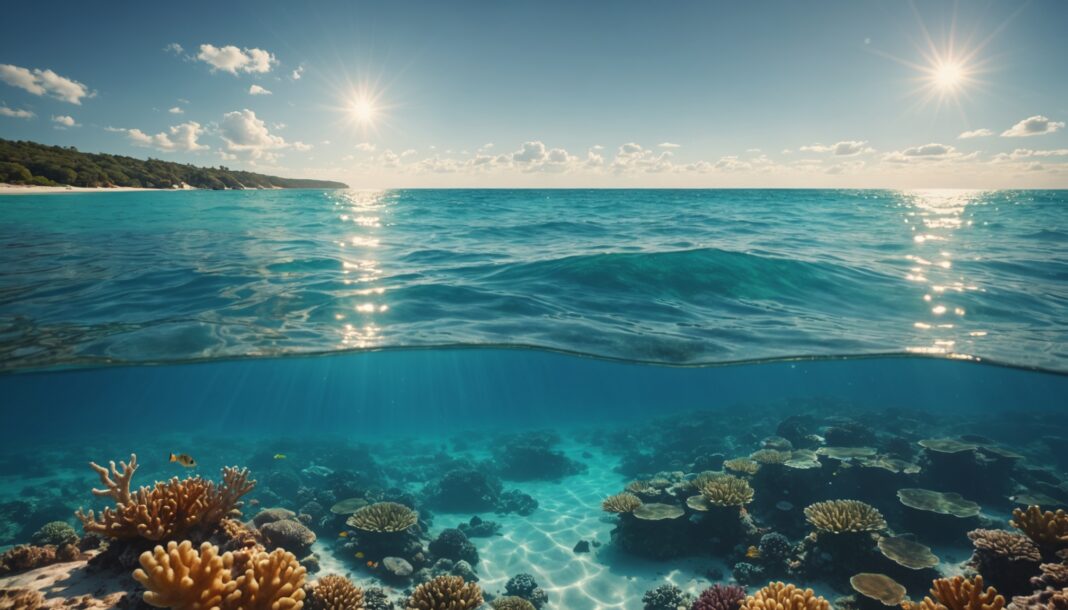

Sauna conditions beneath the waves: marine heat waves have never raged as fiercely as they did in the summer of 2026, and the world's ocean has just written an unflattering chapter in its thermal history. July will go down as the hottest month ever recorded at the sea surface, according to data from the European Copernicus program. A record that doesn't fall alone: in its wake, it drags down corals, oysters, and schools of fish, putting marine ecology back at the center of the news.
An Ocean Thermometer Gone Haywire
The numbers speak for themselves. In June 2026, 82% of the ocean surface was experiencing marine heat wave conditions, with an average temperature of 20.98°C — a record that already topped the one set in June 2024 (20.89°C). The following month drove the point home: July 2026 reached an average of 20.96°C at the sea surface, surpassing the previous peak set in 2023. In August, satellite readings climbed as high as 21.1°C worldwide. Record heat confirmed month after month, now trackable in near real time thanks to satellite scientific monitoring.
French Waters Under Pressure Too
You don't need to cross the Atlantic to feel the difference: July 2026 became the hottest July ever recorded in French waters since measurements began in 1981. The Bay of Biscay is running +3.1°C above seasonal norms, the Mediterranean +3°C, and even the English Channel, usually cooler, is up +2.3°C. This trend fits right into the already worrying climate assessment drawn up for France in recent months.
Corals, Oysters, Fish: Biodiversity Pays a Steep Price
Warmer water isn't just about more pleasant swimming. Scientists list a series of ecological dominoes:
- Accelerated coral bleaching, weakened by thermal stress;
- Forced migration of many fish species toward cooler waters, with direct consequences for coastal fishing;
- Disrupted reproductive cycles for several marine species;
- Upended life cycles for oysters in French oyster farms, facing earlier and more intense marine heat waves.
For ocean industry professionals, the bill could get heavier if the trend continues. A signal that echoes, in its own way, the already visible effects of drought on freshwater resources in France: when the climate runs wild, land and sea pay the price together.
El Niño Lurking for New Records
Oceanographers aren't hiding their concern: a particularly strong El Niño episode is brewing for the winter of 2026-2027. Combined with underlying global warming, this natural phenomenon could push ocean temperatures even higher in the months ahead. Enough to turn a one-off record into a lasting trend: marine heat waves could well become the new summer normal, with the ocean playing a central — and increasingly unstable — role in regulating the global climate.
Frequently Asked Questions
What Is a Marine Heat Wave?
A marine heat wave is a period during which the ocean's surface temperature significantly and persistently exceeds seasonal norms in a given area, over several days or even weeks. Just like on land, it can have serious consequences for ecosystems.
Why Are the Oceans Heating Up So Much in 2026?
Underlying global warming, which drives oceans to absorb a growing share of the planet's excess heat, is combining this year with natural dynamics such as a developing El Niño episode, amplifying the records observed.
Which Marine Species Are Most at Risk?
Corals, highly sensitive to thermal stress, are on the front line, facing the risk of bleaching. Species whose reproductive cycles depend on water temperature, such as oysters, along with certain fish forced to migrate toward cooler waters, are also affected.
Sources
Franceinfo — Climate Crisis
Ifremer — Coastal Monitoring
Arkcity — Marine Heat Waves 2026
Greenwashing: The EU's Anti-Greenwashing Directive France Hasn't Transposed Yet
Since September 27, 2026, European Union member states have had to apply strict rules against greenwashing: this is the date the directive (EU) 2024/825, nicknamed EmpCo, entered into application. The problem: France has still not transposed the text into its…
Climate in France: What the First Annual Impact Report Reveals (and How to Prepare)
France has just equipped itself with an official thermometer for the climate crisis. By publishing the first annual report on the impacts of climate change in France, the government has put precise figures on a reality that many are already…
Summer 2026: France and Europe Shatter Sunshine Records
Nearly uninterrupted sunshine, electric meters spinning in the best possible way: summer 2026 will go down in the continent's climate and energy history books. According to official data from Météo-France (the French national meteorological service), five Western European countries recorded,…

European Sustainable Development Week: The Spotlight on Responsible Eating
Starting September 18 and running through October 8, France is taking part in European Sustainable Development Week (SEDD), an annual highlight held across Europe. Local governments, businesses, schools, nonprofits, and ordinary citizens are invited to organize or join concrete actions…
PFAS in Tap Water: The Polluter-Pays Fee Finally Takes Effect
After more than a year of delay, the polluter-pays principle finally applies to PFAS discharges into water. Since September 1, 2026, industrial companies that dump these “forever chemicals” must pay a fee — a landmark measure in our environment and…
Electric Taxis: Up to €5,500 in Aid for Drivers
Driving all day to transport passengers is one of the most intensive uses a car can get. To speed up the electric transition of this heavily used fleet, the French government has introduced a financial aid program dedicated to taxis,…
Plastic Bottle Deposit Scheme: Government Drops Mandatory National System
So much for the dream of a mandatory plastic bottle deposit scheme across France. The government has just given up on requiring municipalities to adopt a national deposit system for plastic bottles, opting instead for an opt-in approach limited to…

Public Procurement: Environmental Criteria Become Mandatory, the End of Price-Only Bids
Starting August 21, 2026, a page turns for companies that respond to public tenders in France. The Climate and Resilience Law of 2021 fully takes effect on its public procurement provisions: it will no longer be possible for a public…
This article was written with the help of artificial intelligence. Editorial policy