
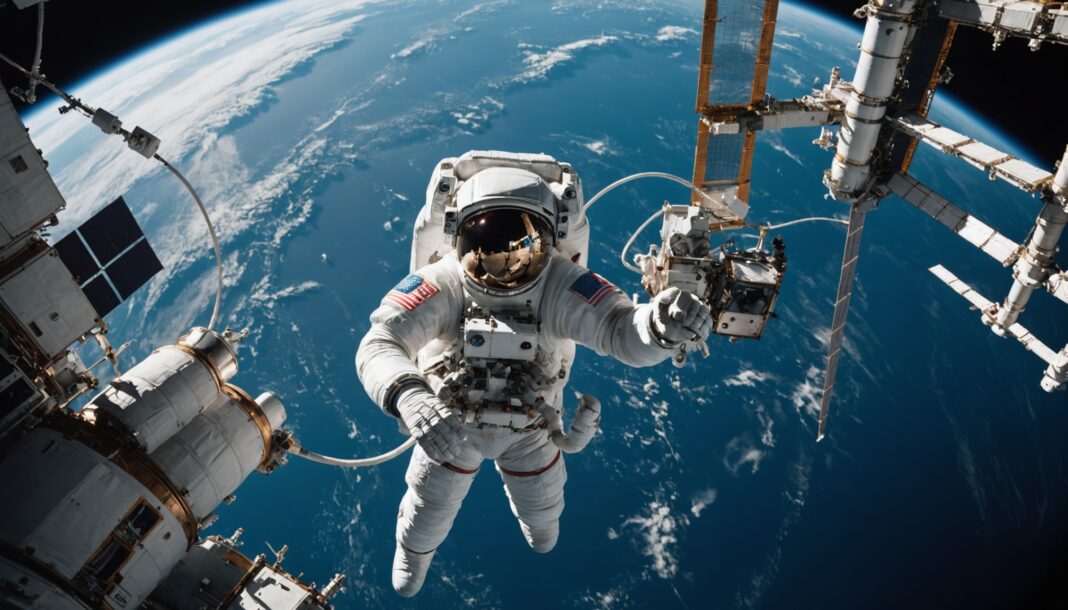

On August 18, 2026, Sophie Adenot became the first French astronaut to perform a spacewalk. It was a widely celebrated feat, but the story didn't end there: the mission had to be repeated a week later, on August 25, to finish a job that seized bolts and stubborn connectors had made impossible to complete on the first try. Here's a look back at the technical behind-the-scenes of an operation far more complicated than it appeared.
A Strategic Antenna, Two Attempts
The goal of both spacewalks was the same: replace the SGANT2 antenna, which provides high-speed communications between the International Space Station and Earth. On August 18, Sophie Adenot and American astronaut Anil Menon spent 6 hours and 23 minutes in the vacuum of space removing the faulty antenna and temporarily securing it to the station's structure — without managing to install the new equipment. It took a second spacewalk, on August 25, to complete the installation on the Z1 truss after overcoming the difficulties encountered during the first attempt.
Why a Simple Antenna Required Two Spacewalks
This setback illustrates a side of spacesuit work that rarely gets attention: every movement, already slowed by thick gloves and the absence of gravity cues, can be stopped by an unforeseen mechanical detail. Bolts seized by years of extreme thermal exposure and stubborn electrical connectors were enough to turn a planned maintenance operation into a two-spacewalk marathon. This is the same kind of technical surprise discussed in a previous article on the differences between SpaceX's rockets and Boeing's Starliner, where equipment reliability remains the main risk factor in space missions.
A Particularly Busy Month for French Space News
- Sophie Adenot's two spacewalks were part of a jam-packed August 2026 for the French space sector, also marked by the launch of Ariane 6 (mission VA269) on August 27 from the Guiana Space Center, carrying the European weather satellite MTG-I2.
- It was Ariane 6's first mission to geostationary orbit, a strategic slot for European weather observation.
- This momentum will be at the heart of the international space summit scheduled in Paris on September 9 and 10, 2026, where the reliability of equipment in orbit is expected to be among the topics discussed.
- Another space event that month had already drawn attention: the deliberate impact of a SpaceX rocket stage on the Moon, an experiment closely watched by the scientific community.
What This Mission Reveals About the Future of Orbital Maintenance
As the International Space Station ages, with its decommissioning now planned for the end of the decade, this type of incident is expected to become more common. Space agencies are already studying robotic maintenance solutions to limit human spacewalks to only the operations that truly require them, reducing both the risks and the length of astronauts' exposure.
Frequently Asked Questions
Why wasn't the first spacewalk on August 18 enough?
Seized bolts and electrical connectors that were difficult to handle prevented Sophie Adenot and Anil Menon from installing the new antenna within the allotted time; they were only able to remove the old equipment.
What is the SGANT2 antenna used for?
It provides high-speed communications between the International Space Station and ground control centers.
How long did the first spacewalk last?
It lasted 6 hours and 23 minutes, a typical duration for this type of orbital maintenance operation.
Sources
- Cité de l'espace — Sophie Adenot to perform a second spacewalk
- Quasa — Sophie Adenot in the void for 6h23, but the antenna remains to be installed
- Cap-Infos — Ariane 6 VA269: Kourou prepares for the launch of the MTG-I2 weather satellite

Nvidia Buys Hugging Face in 2026: What Changes for Open Source AI
American graphics chip maker Nvidia officially announced in early September 2026 the acquisition of Hugging Face, the French-American platform that in just a few years became the world reference for open source artificial intelligence. The amount of the deal, confirmed…

Temporal Photonic Crystal: Physicists Tame Light at Lightning Speed
What if light could be shaped, slowed down, or amplified in the blink of a trillionth of a second, without spending an ounce of extra energy? That's exactly what a French-German research team has just achieved, bringing together French laboratories…

Labeling Deepfakes and AI Content: What's Now Mandatory in Europe
Since August 2, 2026, a new obligation stemming from the European regulation on artificial intelligence (the AI Act) has concretely applied to the digital daily life of French citizens: deepfakes and AI-generated content must now be labeled. A discreet regulatory…
A Muon Laser That Can See Through Concrete
An international team of physicists has achieved an unprecedented milestone in imaging dense materials. Using an ultra-powerful muon laser, researchers at the Extreme Light Infrastructure – Nuclear Physics (ELI-NP) facility in Romania managed to photograph an object hidden behind two…
Idefix: The 25-Kilogram French Rover Set to Explore a Moon of Mars
A tiny craft weighing just 25 kilograms has just left Earth for one of the most delicate missions ever attempted in the solar system: landing on a moon of Mars with almost no gravity. The Idefix rover, jointly developed by…
On August 5, 2026, a SpaceX Rocket Stage Will Hit the Moon: What Scientists Will Observe
On August 5, 2026, a piece of SpaceX rocket will crash into the Moon. The object is nothing like an exploration spacecraft: it's a Falcon 9 upper stage turned space junk, adrift for eighteen months. Far from being a mere…
Hydrogen Turbine: Electricity Generated by Controlled Explosions
What if we could generate electricity from small, perfectly controlled explosions, with no mechanical compressor at all? That's the challenge taken on by German engineers at the Karlsruhe Institute of Technology (KIT), who have just run a new kind of…
Inouye Telescope Reveals Unprecedented Swirls on the Sun's Surface
The Sun has just given up a secret decades in the making. Thanks to the Daniel K. Inouye Solar Telescope, perched atop the Haleakalā volcano in Hawaii, an international team of astronomers has photographed thousands of tiny plasma vortices blanketing…
This article was written with the help of artificial intelligence. Editorial policy