

An international team of physicists has achieved an unprecedented milestone in imaging dense materials. Using an ultra-powerful muon laser, researchers at the Extreme Light Infrastructure – Nuclear Physics (ELI-NP) facility in Romania managed to photograph an object hidden behind two meters of concrete. A feat that opens the way to new applications in infrastructure inspection and security.
A Technology That Relies on Particles from the Cosmos
Muons are particles similar to electrons, but about 200 times heavier. This mass allows them to pass easily through several meters of rock, metal, or concrete — a property already used to probe the interior of the Egyptian pyramids or volcanoes. Until now, this muography depended on muons produced naturally by cosmic rays, which are rare and impossible to direct.
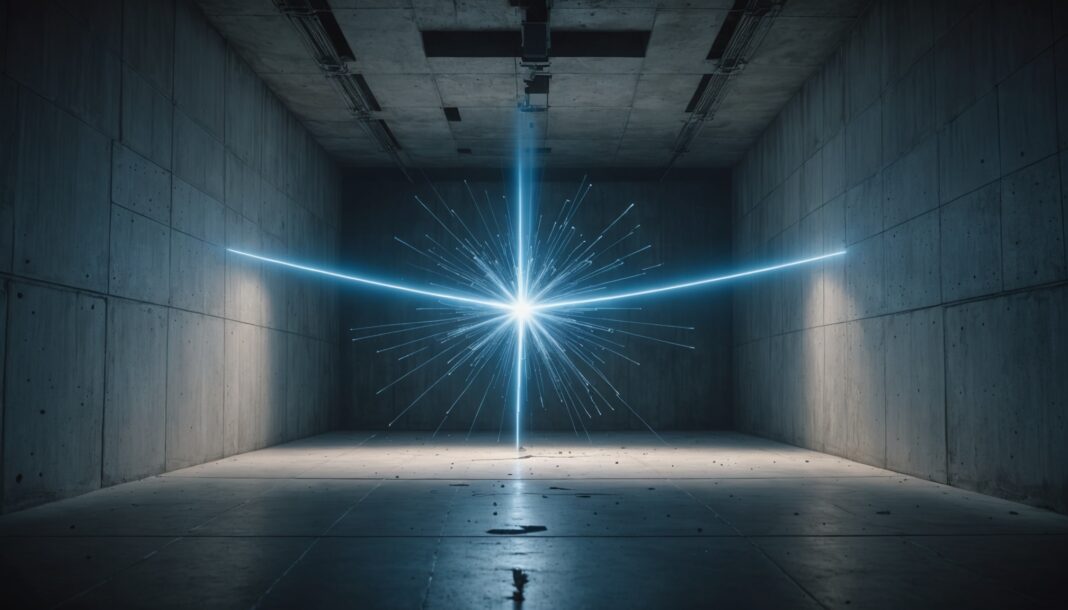
The novelty lies in the production method: a very high-power laser is directed at a gas, accelerating its electrons to considerable energy. These electrons then collide with a solid target, generating radiation that in turn produces pairs of muons — this time artificial and steerable. Detectors placed 42 meters from the source thus recorded the shadow of a stack of lead bricks hidden behind a two-meter concrete wall, with an exact match in position and dimensions.
Promising Real-World Applications
Unlike cosmic muography, which sometimes requires weeks of exposure to obtain a usable image, a laser-produced muon beam could eventually be generated on demand. The researchers point to several possibilities:
- Non-destructive inspection of bridges, dams, and historic buildings
- Monitoring of large industrial infrastructure
- Detection of nuclear materials hidden in containers or vehicles
- Inspection of thick metal parts in heavy industry
These uses fit into a broader trend in which basic research quickly leads to practical tools, much like this vaccine designed by artificial intelligence that recently entered human trials.
A Breakthrough Still Being Refined
The authors of the experiment remain cautious: the resolution of the images obtained is still low, and only about 90% of the detected particles were actually muons, with the rest constituting background noise that must be filtered out. Several years of development will be needed before a portable, field-ready device can be considered. But the proof of concept has now been established: producing muons on demand, without waiting for cosmic rays, is possible.
This ability to generate ever more precise digital and scientific tools is a reminder that innovation isn't confined to laboratories: it also flows into everyday uses, as shown by solutions such as NéoProfs and Flashcardlet in education, or collaborations blending urban culture and innovation for the general public.
Frequently Asked Questions
What is muography?
It's an imaging technique that uses muons, particles capable of passing through very dense materials, to reveal the internal structure of an object without needing to open it, somewhat like an X-ray on a very large scale.
How does this muon laser change things?
Until now, muography depended on muons from cosmic rays, which are random and slow to collect. Producing them with a laser would make it possible to generate a beam on demand, much faster to use.
When will this technology be usable in practice?
Not for several years: the resolution of the images still needs to be significantly improved, and current facilities remain confined to research laboratories like ELI-NP.
Sources
Find more news in our Science and Technology, Digital – High Tech, and Internet – Digital Life sections.

Labeling Deepfakes and AI Content: What's Now Mandatory in Europe
Since August 2, 2026, a new obligation stemming from the European regulation on artificial intelligence (the AI Act) has concretely applied to the digital daily life of French citizens: deepfakes and AI-generated content must now be labeled. A discreet regulatory…
Apophis 2029: The Asteroid That Will Pass Closer to Earth Than Its Satellites
On April 13, 2029, a 450-meter-long space rock will pass closer to Earth than some of our own satellites. Its name: Apophis. No panic, no science fiction — NASA has calculated its trajectory down to the kilometer, and the flyby…

France 2030: The Tech Start-Ups Rewarded by the French State
On September 16, 2026, in Paris, the French government honored 109 winners at the France 2030 innovation competition ceremony, in the presence of Anne Le Hénanff, Minister for Artificial Intelligence and Digital Affairs, and Bruno Bonnell, Secretary General for Investment.…
Inouye Telescope Reveals Unprecedented Swirls on the Sun's Surface
The Sun has just given up a secret decades in the making. Thanks to the Daniel K. Inouye Solar Telescope, perched atop the Haleakalā volcano in Hawaii, an international team of astronomers has photographed thousands of tiny plasma vortices blanketing…

Temporal Photonic Crystal: Physicists Tame Light at Lightning Speed
What if light could be shaped, slowed down, or amplified in the blink of a trillionth of a second, without spending an ounce of extra energy? That's exactly what a French-German research team has just achieved, bringing together French laboratories…

Apple Ad With a Baby: Why Italy Demanded Its Removal
An Apple ad showing a very young child with an iPhone has just disappeared from a large billboard in Milan. The Apple brand had to pull the visual after an Italian public authority in charge of child protection intervened, reigniting…
Wi-Fi: Your Router Can Now Identify You Without a Camera, German Study Reveals
An ordinary Wi-Fi router, without a camera or any special sensor, can now be enough to identify a person with near 100 percent accuracy. That's the conclusion of a study conducted by the Karlsruhe Institute of Technology (KIT), in Germany,…

Ancient Life on Mars: What the Rock Studied by Perseverance Really Reveals
NASA's Perseverance rover keeps digging through Jezero Crater on Mars. A study published in late June 2026 in the journal Science Advances details the discovery of hundreds of traces of complex organic carbon in the ancient river valley of Neretva…
This article was written with the help of artificial intelligence. Editorial policy