



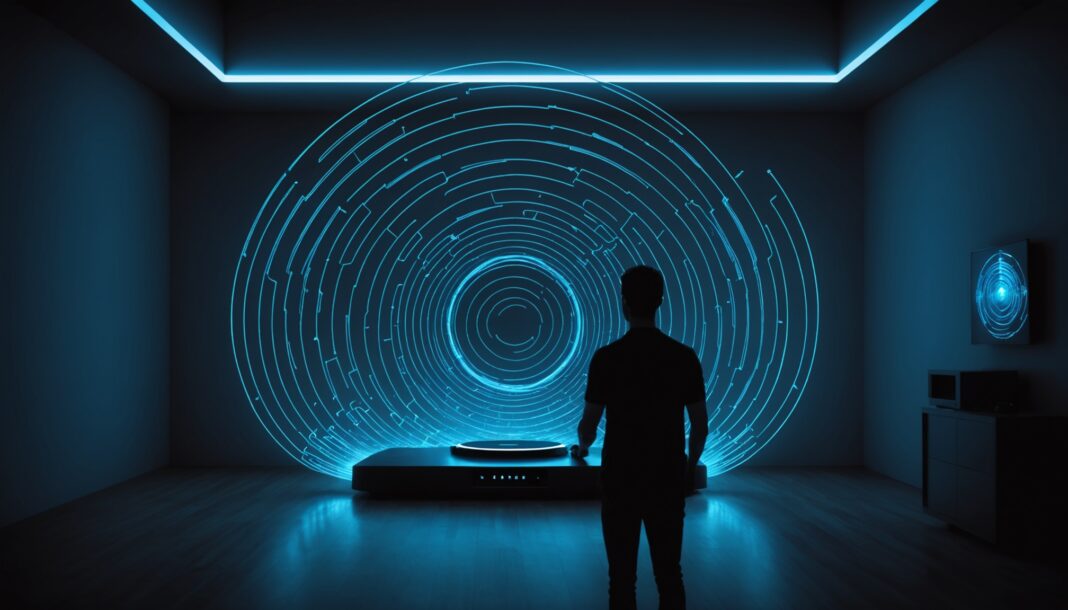

An ordinary Wi-Fi router, without a camera or any special sensor, can now be enough to identify a person with near 100 percent accuracy. That's the conclusion of a study conducted by the Karlsruhe Institute of Technology (KIT), in Germany, which will be presented at the ACM CCS computer security conference in Taipei in August 2026. It's reviving the debate over digital life and the limits of the technologies we use every day without a second thought.
How Ordinary Wi-Fi Can “See” Without a Camera
The method relies on Beamforming Feedback Information (BFI), technical signals that Wi-Fi devices constantly exchange with their router to optimize network quality. These exchanges, transmitted without encryption, aren't meant to identify anyone: they normally serve to adjust the direction of the radio signal. But researchers at KASTEL, KIT's cybersecurity institute, have shown that the human body slightly alters the propagation of these waves depending on position, body shape, and movement. By analyzing these variations, it becomes possible to reconstruct a kind of radio fingerprint unique to each individual.
Unlike other experimental radio-wave detection techniques, this approach requires neither LIDAR nor specialized equipment to capture CSI (Channel State Information) data: ordinary commercial Wi-Fi equipment is enough.
Accuracy Tested on 197 Participants
To validate their method, the researchers ran tests on 197 people. The result: the correct identification rate is close to 100 percent, regardless of the observation angle or the person's gait. In other words, neither moving the virtual camera nor changing one's walk allows someone to escape recognition once their radio profile has been recorded.
- No camera or specialized sensor is needed.
- The person being observed doesn't need to carry a connected device themselves.
- Turning off your own phone isn't enough: it's enough for other active Wi-Fi devices to be nearby.
What Are the Risks to Privacy?
Professor Thorsten Strufe, who supervised the research, sums up the stakes bluntly: this technology “turns every router into a potential surveillance tool.” The risk mainly concerns places where Wi-Fi is everywhere and foot traffic is anonymous: cafés, offices, shopping malls, building lobbies. A person could be spotted and tracked from one location to another without any camera being visible, which makes detecting abusive surveillance considerably harder.
The researchers also point to an even more troubling use in contexts where individual freedoms are already fragile, particularly under authoritarian regimes, where this kind of invisible surveillance could add to existing tools of control. It's an issue that touches on the legal protection of privacy as much as on the security of digital infrastructure.
Can You Protect Yourself?
For now, there's no consumer-level fix: the flaw lies in the very nature of the Wi-Fi protocol, not in a setting an individual could change from their smartphone. The researchers are calling on standards bodies to build protections into future versions of the Wi-Fi standard, for example by encrypting or limiting exposure of beamforming signals. In the meantime, vigilance falls to router manufacturers and to makers of apps and software that could exploit this type of data.
Frequently Asked Questions
Do you need to hack a Wi-Fi network to identify someone this way?
No. The method relies on technical signals (BFI) normally exchanged between devices and the router, without requiring any network intrusion or password.
Does turning off your phone protect you from this kind of identification?
Not completely: it's enough for another active Wi-Fi device to be nearby for the returned signal to detect a human presence in the area.
Is this technology already used in commercial products?
No, for now it's a research demonstration presented in an academic setting. But it highlights a structural flaw that future Wi-Fi standards will need to fix.
Sources
ScienceDaily ·
Cybernews ·
SciTechDaily
Sophie Adenot in Space: The Technical Behind-the-Scenes of an Eventful Spacewalk
On August 18, 2026, Sophie Adenot became the first French astronaut to perform a spacewalk. It was a widely celebrated feat, but the story didn't end there: the mission had to be repeated a week later, on August 25, to…
Idefix: The 25-Kilogram French Rover Set to Explore a Moon of Mars
A tiny craft weighing just 25 kilograms has just left Earth for one of the most delicate missions ever attempted in the solar system: landing on a moon of Mars with almost no gravity. The Idefix rover, jointly developed by…
A Muon Laser That Can See Through Concrete
An international team of physicists has achieved an unprecedented milestone in imaging dense materials. Using an ultra-powerful muon laser, researchers at the Extreme Light Infrastructure – Nuclear Physics (ELI-NP) facility in Romania managed to photograph an object hidden behind two…
Perseids: Why the Night of August 12-13 Will Be Exceptional for Watching Shooting Stars
Every summer, the same question comes up among stargazing enthusiasts and casual onlookers alike: what's the best night to watch shooting stars? This year, the answer is particularly clear-cut. On the night of August 12-13, the sky will host the…
Humanoid Robot Breaks Usain Bolt's 100-Meter World Record
The Usain Bolt myth has just fallen — though not on a human track. On the weekend of August 22 and 23, 2026, in Beijing, a humanoid robot ran the 100 meters in 9.39 seconds, breaking the 9.58-second world record…

France 2030: The Tech Start-Ups Rewarded by the French State
On September 16, 2026, in Paris, the French government honored 109 winners at the France 2030 innovation competition ceremony, in the presence of Anne Le Hénanff, Minister for Artificial Intelligence and Digital Affairs, and Bruno Bonnell, Secretary General for Investment.…

Hydrogen Turbine: Electricity Generated by Controlled Explosions
What if we could generate electricity from small, perfectly controlled explosions, with no mechanical compressor at all? That's the challenge taken on by German engineers at the Karlsruhe Institute of Technology (KIT), who have just run a new kind of…

Mercury: European Probe BepiColombo Completes Its Riskiest Maneuver Yet
Eight years of travel, 63 million kilometers from the Sun, and a maneuver that one of the mission's officials compared to… a rocket launch. The European probe BepiColombo has just cleared the trickiest stage of its mission to Mercury, the…
This article was written with the help of artificial intelligence. Editorial policy