


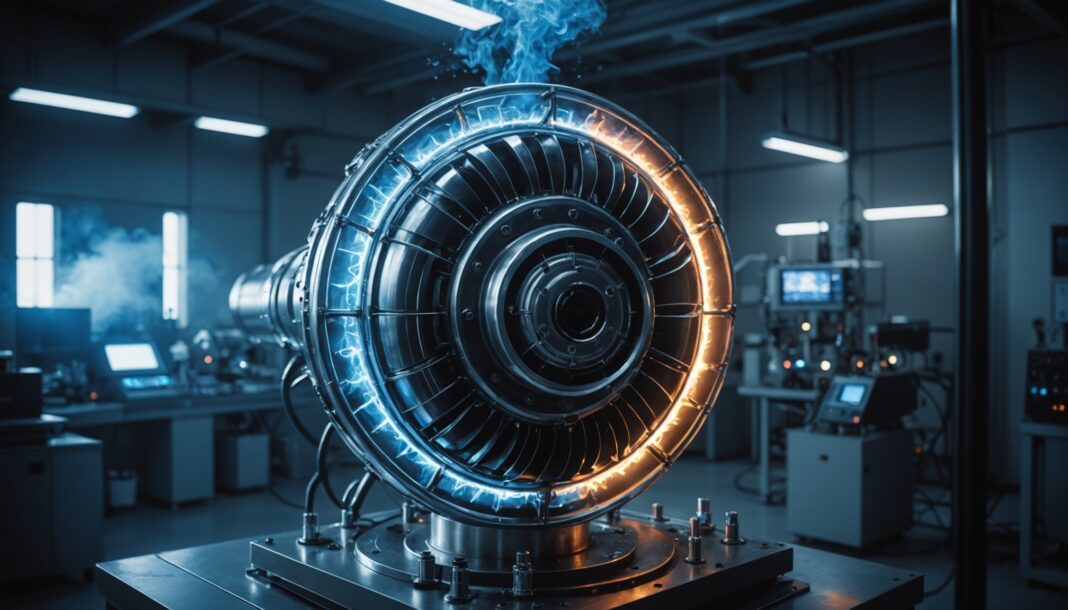

What if we could generate electricity from small, perfectly controlled explosions, with no mechanical compressor at all? That's the challenge taken on by German engineers at the Karlsruhe Institute of Technology (KIT), who have just run a new kind of hydrogen turbine for 303 seconds, a record that smashes NASA's previous mark of 250 seconds. It's a technical feat that could change the game for the gas turbines of tomorrow.
The Compressor: An Energy Sink
In a conventional gas turbine, roughly half of the energy produced is used solely… to compress air before combustion. The compressor is essential, but it eats up a huge share of the machine's overall efficiency. The idea behind the KIT researchers' work: simply remove this costly, power-hungry component and let combustion itself generate the pressure needed.
In practice, the system relies on detonation waves: combustion fronts that travel faster than sound inside the chamber, creating instabilities, vortices, and shock waves that drive up pressure without any external mechanical intervention. Hydrogen is particularly well suited to this process because it reacts very quickly and produces stable, reproducible pressure rises.
A Record That Confirms a Historic First
This isn't the first time the KIT team has made waves: back in February 2026, they managed to generate electricity for the first time ever with a compressorless hydrogen turbine. The new 303-second run confirms that the technology isn't just a one-off trial, but can operate steadily over a meaningful period, surpassing the previous record held by NASA.
- Elimination of the mechanical compressor, the main source of efficiency loss.
- Pressure generated directly by detonation waves in the combustion chamber.
- Hydrogen as fuel: no CO2 emissions from combustion, provided it is produced from renewable energy sources.
- Continuous operation record extended to 303 seconds, up from 250 seconds for the previous NASA record.
Toward Lighter, Cheaper, More Efficient Turbines
The researchers are targeting applications on two timelines. In the short term, decarbonized electricity production, with turbines that are simpler, cheaper to build, and potentially more efficient than a conventional system. In the longer term, the stated ambition is to bring this technology to the aviation sector, where the weight savings from removing the compressor could have a major impact on aircraft fuel consumption.
Still, there's a long road ahead between a lab test lasting a few minutes and an industrial turbine capable of running continuously, day after day, under real-world conditions. The next steps announced by the team focus on extending the operating duration and optimizing the system's overall electrical efficiency.
This advance fits into the broader global race for low-carbon technologies, at a time when many manufacturers are simultaneously exploring other clean energy production paths, both in high-tech fields and in heavy-industry energy sectors.
Frequently Asked Questions
What makes this hydrogen turbine different from conventional turbines?
It has no mechanical compressor: the pressure needed for combustion is generated directly by detonation waves inside the chamber, which limits the energy losses typically associated with compression.
What record did the KIT researchers just break?
Their turbine ran continuously for 303 seconds, surpassing the previous record of 250 seconds held by NASA for this type of technology.
What could this technology be used for in the future?
The researchers are first targeting decarbonized electricity production, and later, in the longer term, aviation applications thanks to lighter, more efficient turbines.
Sources
- ScienceDaily – This hydrogen turbine turns controlled explosions into electricity
- TechXplore – Compressorless hydrogen turbine runs 303 seconds, beating NASA's record
- CORDIS (European Commission) – Gas turbine runs with 100% green hydrogen, a world first
Idefix: The 25-Kilogram French Rover Set to Explore a Moon of Mars
A tiny craft weighing just 25 kilograms has just left Earth for one of the most delicate missions ever attempted in the solar system: landing on a moon of Mars with almost no gravity. The Idefix rover, jointly developed by…
Apophis 2029: The Asteroid That Will Pass Closer to Earth Than Its Satellites
On April 13, 2029, a 450-meter-long space rock will pass closer to Earth than some of our own satellites. Its name: Apophis. No panic, no science fiction — NASA has calculated its trajectory down to the kilometer, and the flyby…

Inouye Telescope Reveals Unprecedented Swirls on the Sun's Surface
The Sun has just given up a secret decades in the making. Thanks to the Daniel K. Inouye Solar Telescope, perched atop the Haleakalā volcano in Hawaii, an international team of astronomers has photographed thousands of tiny plasma vortices blanketing…
An Unexpected Comet Spotted by the Euclid Space Telescope
A telescope designed to photograph billions of distant galaxies wasn't supposed to cross paths with a visitor from our own solar system. Yet that's exactly what just happened to Euclid, the European Space Agency's (ESA) space telescope, which unexpectedly captured…

France 2030: The Tech Start-Ups Rewarded by the French State
On September 16, 2026, in Paris, the French government honored 109 winners at the France 2030 innovation competition ceremony, in the presence of Anne Le Hénanff, Minister for Artificial Intelligence and Digital Affairs, and Bruno Bonnell, Secretary General for Investment.…

ChatGPT Brings Ads to Your Conversations: What's Changing in France
Until now, chatting with ChatGPT remained a space free of banners or ads. That changes starting August 24: OpenAI is rolling out its first ads inside ChatGPT in France, along with thirty other European markets. After six months of testing…

Labeling Deepfakes and AI Content: What's Now Mandatory in Europe
Since August 2, 2026, a new obligation stemming from the European regulation on artificial intelligence (the AI Act) has concretely applied to the digital daily life of French citizens: deepfakes and AI-generated content must now be labeled. A discreet regulatory…
Sophie Adenot in Space: The Technical Behind-the-Scenes of an Eventful Spacewalk
On August 18, 2026, Sophie Adenot became the first French astronaut to perform a spacewalk. It was a widely celebrated feat, but the story didn't end there: the mission had to be repeated a week later, on August 25, to…
This article was written with the help of artificial intelligence. Editorial policy