

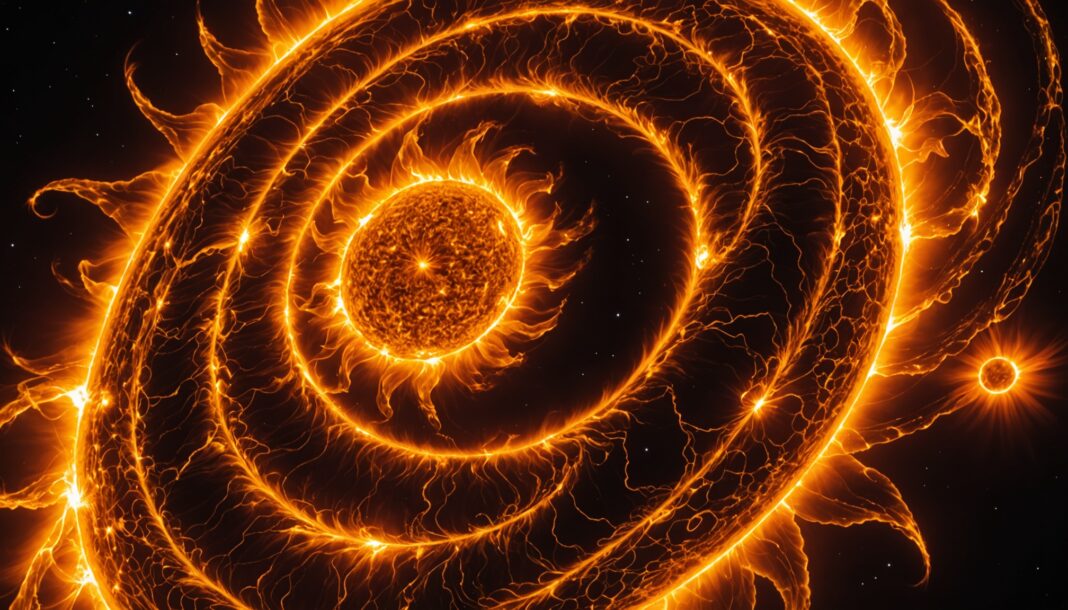

The Sun has just given up a secret decades in the making. Thanks to the Daniel K. Inouye Solar Telescope, perched atop the Haleakalā volcano in Hawaii, an international team of astronomers has photographed thousands of tiny plasma vortices blanketing the surface of our star for the first time. Published on August 5 in the journal Nature, these unprecedentedly sharp images could finally explain why the Sun's corona is far hotter than its surface, a mystery that has puzzled physicists since the 1970s.
An Instrument Capable of Seeing Details as Small as 20 Kilometers
With its four-meter-diameter mirror, the Inouye Telescope is now the most powerful solar instrument in the world. It can distinguish structures as small as 20 kilometers on the Sun's surface, a remarkable feat given that the star measures 1.4 million kilometers in diameter. It was this exceptional resolution that made it possible to spot, near a sunspot observed in April 2025, hundreds of vortices spaced just 50 to 65 kilometers apart, invisible until now with previous instruments.
These structures correspond to a phenomenon long theorized by physicists known as Kelvin-Helmholtz instabilities, a mechanism that occurs when two layers of matter move at different speeds, somewhat like wind forming ripples on the surface of water. On the Sun, it is streams of plasma rubbing against one another that generate these incandescent mini-tornadoes.
The Key to a Fifty-Year-Old Mystery
The discovery is of particular interest to scientists for a specific reason: it could shed light on one of the oldest mysteries in solar physics, that of coronal heating. While the Sun's surface sits at a temperature of about 5,500 degrees, its outer atmosphere, the corona, climbs to several million degrees. This difference seems illogical, since energy should normally decrease the farther one moves from the heat source.
According to researchers, including Sami Solanki, director of the Max Planck Institute for Solar System Research, these vortices could act as veritable engines, continually twisting magnetic field lines and thereby releasing the energy needed to heat the corona to such extreme temperatures. This mechanism would also help scientists better understand the formation of solar flares and coronal mass ejections, those violent phenomena capable of disrupting satellites and power grids on Earth.
Concrete Implications for Space Weather
Beyond pure scientific curiosity, this advance has very concrete implications. A better understanding of the dynamics of the solar corona would help improve space weather forecasting models, an increasingly strategic issue as societies grow more dependent on low-orbit satellites, GPS networks, and telecommunications systems sensitive to geomagnetic storms. Upcoming observation campaigns with the Inouye Telescope should help map these vortices more broadly and determine whether the phenomenon occurs across the entire solar surface or is concentrated around magnetically active regions.
This breakthrough also illustrates the dramatic progress made in astronomical instrumentation: where previous telescopes showed only blurry blotches, Inouye now reveals an intricate choreography of plasma in constant motion, opening a new chapter for scientific research and for all those passionate about cutting-edge technological innovation.
Frequently Asked Questions
What is a Kelvin-Helmholtz instability?
It is a physical phenomenon that occurs when two layers of fluid (or plasma) move at different speeds along a shared boundary. This friction creates vortices, somewhat like wind rippling the surface of a lake.
Why is the solar corona hotter than the Sun's surface?
That is precisely the mystery this discovery seeks to solve. Scientists believe that mechanisms such as these plasma vortices release magnetic energy that heats the Sun's outer atmosphere well beyond the temperature of its surface.
Could this discovery improve space weather forecasting?
Yes. By better understanding how energy circulates through the solar atmosphere, researchers hope to refine the models used to anticipate solar flares and their effects on satellites, GPS, and power grids on Earth.
Sources

Nvidia Buys Hugging Face in 2026: What Changes for Open Source AI
American graphics chip maker Nvidia officially announced in early September 2026 the acquisition of Hugging Face, the French-American platform that in just a few years became the world reference for open source artificial intelligence. The amount of the deal, confirmed…
Ancient Life on Mars: What the Rock Studied by Perseverance Really Reveals
NASA's Perseverance rover keeps digging through Jezero Crater on Mars. A study published in late June 2026 in the journal Science Advances details the discovery of hundreds of traces of complex organic carbon in the ancient river valley of Neretva…

Apple Ad With a Baby: Why Italy Demanded Its Removal
An Apple ad showing a very young child with an iPhone has just disappeared from a large billboard in Milan. The Apple brand had to pull the visual after an Italian public authority in charge of child protection intervened, reigniting…

Labeling Deepfakes and AI Content: What's Now Mandatory in Europe
Since August 2, 2026, a new obligation stemming from the European regulation on artificial intelligence (the AI Act) has concretely applied to the digital daily life of French citizens: deepfakes and AI-generated content must now be labeled. A discreet regulatory…

France 2030: The Tech Start-Ups Rewarded by the French State
On September 16, 2026, in Paris, the French government honored 109 winners at the France 2030 innovation competition ceremony, in the presence of Anne Le Hénanff, Minister for Artificial Intelligence and Digital Affairs, and Bruno Bonnell, Secretary General for Investment.…
Mercury: European Probe BepiColombo Completes Its Riskiest Maneuver Yet
Eight years of travel, 63 million kilometers from the Sun, and a maneuver that one of the mission's officials compared to… a rocket launch. The European probe BepiColombo has just cleared the trickiest stage of its mission to Mercury, the…

Temporal Photonic Crystal: Physicists Tame Light at Lightning Speed
What if light could be shaped, slowed down, or amplified in the blink of a trillionth of a second, without spending an ounce of extra energy? That's exactly what a French-German research team has just achieved, bringing together French laboratories…
Perseids: Why the Night of August 12-13 Will Be Exceptional for Watching Shooting Stars
Every summer, the same question comes up among stargazing enthusiasts and casual onlookers alike: what's the best night to watch shooting stars? This year, the answer is particularly clear-cut. On the night of August 12-13, the sky will host the…
This article was written with the help of artificial intelligence. Editorial policy