

On September 16, 2026, in Paris, the French government honored 109 winners at the France 2030 innovation competition ceremony, in the presence of Anne Le Hénanff, Minister for Artificial Intelligence and Digital Affairs, and Bruno Bonnell, Secretary General for Investment. Behind this number lies a new generation of French technology start-ups that will receive a real financial boost to turn their prototypes into companies.
The i-Lab competition, the oldest of these programs organized by Bpifrance, alone rewarded 69 winners—including 10 Grand Prizes—out of 569 applications received. That's a selection rate of about 20%, for total financial support of €25 million, in the form of grants capped at €600,000 per project.
A Winners' List Dominated by Quantum, AI, and Sustainable Materials
Among the 2026 Grand Prize winners, the QLUSTER project, led by the Kastler Brossel Laboratory (ENS, Collège de France, CNRS), is working on controlling neutral atoms to build quantum processors. It's a field where France is trying not to fall behind, as even industry giants are accelerating their investments—somewhat like the way French tech start-ups are now looking to go international right from their first funding rounds.
Another notable winner: PREMAT, developed at the Paris Institute of Chemical Research (Chimie ParisTech), which has created a chemical recycling technology for polyurethanes—a concrete answer to a type of plastic waste that has long been difficult to recover. In healthcare, LiveRNA is working on mRNA immunotherapies at the Institut Curie, continuing a line of French biomedical research that has already produced spectacular results: it's worth recalling that a universal vaccine designed with the help of artificial intelligence had reached an unprecedented clinical milestone just a few months earlier.
Very Concrete Applications, Far From the Lab
Not all award-winning projects come from basic research. Kyneon is developing an ultra-thin electromagnetic absorber for drones and aircraft, Deeemines is tackling the recycling of brominated plastics from electronic waste, and Ironflow Batteries is working on redox flow battery technology for energy storage—a major industrial challenge at a time when energy efficiency is becoming essential everywhere, even in everyday high-tech gadgets.
- 69 winners in the i-Lab competition, including 10 Grand Prizes
- 569 applications received, a selection rate of nearly 20%
- €25 million in total financial support
- Grant capped at €600,000 per project
- 109 winners across all categories (i-Lab, i-PhD, i-Nov)
Why This Winners' List Matters Beyond the Symbolism
France 2030 is not just a public relations exercise: since 2021, the plan has financed the structuring of entire industries, from energy to healthcare to digital technology. By betting on the early-stage funding of still-fragile technology start-ups, the French government hopes to limit France's dependence on critical technologies developed elsewhere—quantum computing, AI, biotech. Still, the real test starts now: turning a grant and an award into a lasting company capable of raising private funding and scaling up is a path that many winners from previous editions have not completed.
Frequently Asked Questions
Who can apply for the France 2030 innovation competitions?
The i-Lab competition is open to project leaders who want to create an innovative technology company, whether they are researchers, PhD candidates, or entrepreneurs already working on setting up their business. Applications are reviewed by a panel of independent experts convened by Bpifrance.
What is the maximum amount of funding awarded?
For the 2026 edition of the i-Lab competition, the grant is capped at €600,000 per winning project, funded as part of the France 2030 plan.
Does France 2030 only fund technology start-ups?
No: beyond the i-Lab competition dedicated to creating technology companies, the program also includes i-PhD for doctoral candidates and i-Nov for innovation projects led by already-established SMEs and start-ups, covering topics ranging from materials science to biotechnology.
Sources
- Ministry of Higher Education and Research
- Bpifrance — i-Lab Innovation Competition
- PSL University — 2026 i-Lab and i-PhD winners
Hydrogen Turbine: Electricity Generated by Controlled Explosions
What if we could generate electricity from small, perfectly controlled explosions, with no mechanical compressor at all? That's the challenge taken on by German engineers at the Karlsruhe Institute of Technology (KIT), who have just run a new kind of…
An Unexpected Comet Spotted by the Euclid Space Telescope
A telescope designed to photograph billions of distant galaxies wasn't supposed to cross paths with a visitor from our own solar system. Yet that's exactly what just happened to Euclid, the European Space Agency's (ESA) space telescope, which unexpectedly captured…
A Muon Laser That Can See Through Concrete
An international team of physicists has achieved an unprecedented milestone in imaging dense materials. Using an ultra-powerful muon laser, researchers at the Extreme Light Infrastructure – Nuclear Physics (ELI-NP) facility in Romania managed to photograph an object hidden behind two…
Mercury: European Probe BepiColombo Completes Its Riskiest Maneuver Yet
Eight years of travel, 63 million kilometers from the Sun, and a maneuver that one of the mission's officials compared to… a rocket launch. The European probe BepiColombo has just cleared the trickiest stage of its mission to Mercury, the…
Perseids: Why the Night of August 12-13 Will Be Exceptional for Watching Shooting Stars
Every summer, the same question comes up among stargazing enthusiasts and casual onlookers alike: what's the best night to watch shooting stars? This year, the answer is particularly clear-cut. On the night of August 12-13, the sky will host the…
Apple Ad With a Baby: Why Italy Demanded Its Removal
An Apple ad showing a very young child with an iPhone has just disappeared from a large billboard in Milan. The Apple brand had to pull the visual after an Italian public authority in charge of child protection intervened, reigniting…
Nvidia Buys Hugging Face in 2026: What Changes for Open Source AI
American graphics chip maker Nvidia officially announced in early September 2026 the acquisition of Hugging Face, the French-American platform that in just a few years became the world reference for open source artificial intelligence. The amount of the deal, confirmed…
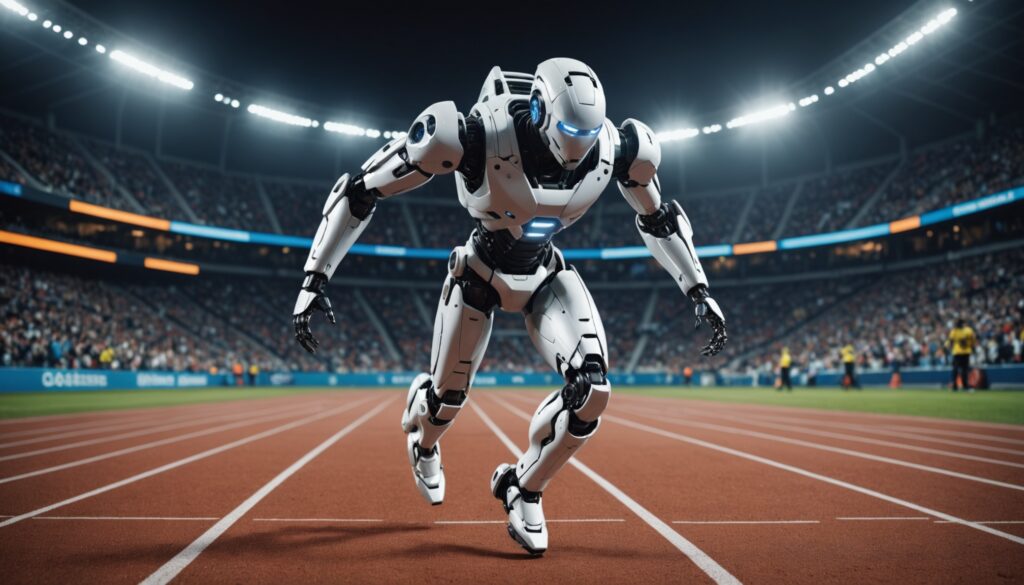
Humanoid Robot Breaks Usain Bolt's 100-Meter World Record
The Usain Bolt myth has just fallen — though not on a human track. On the weekend of August 22 and 23, 2026, in Beijing, a humanoid robot ran the 100 meters in 9.39 seconds, breaking the 9.58-second world record…
This article was written with the help of artificial intelligence. Editorial policy