


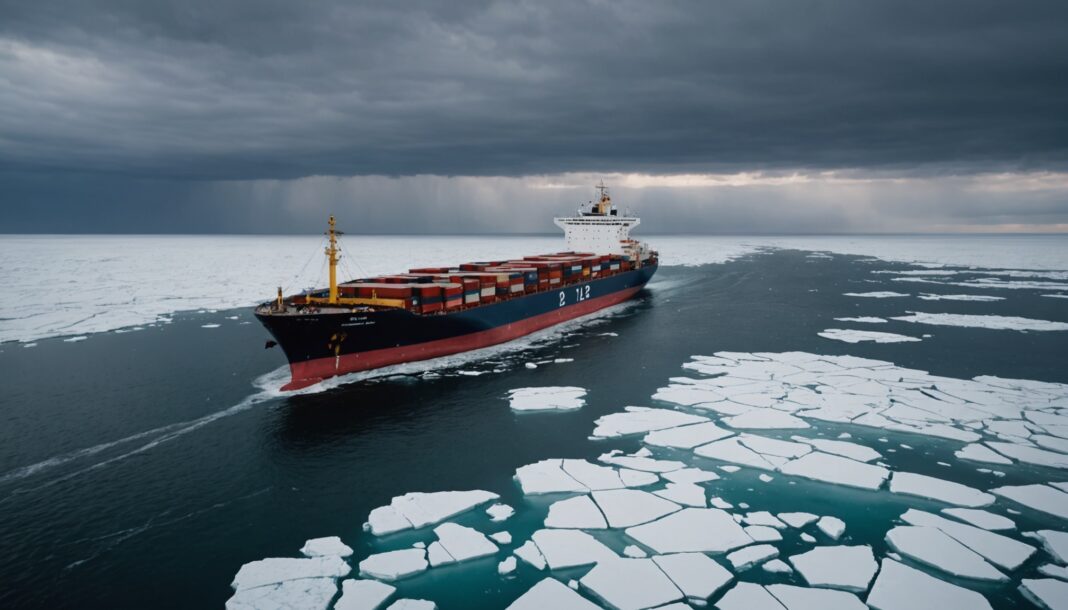

On Saturday, August 22, 2026, a container ship left the South Korean port of Busan bound for Europe. Nothing extraordinary at first glance, except that this ship will take neither the Suez Canal nor the Strait of Malacca: it will travel the Arctic shipping route, sailing along the Russian coast before reaching Great Britain, the Netherlands, and then Poland. A test voyage that could redraw the map of global trade.
A Route Reshaping Global Logistics
The ship, the Panstar Acro, a container vessel operated by Busan-based shipping company PanStar Line, is carrying about 2,800 twenty-foot equivalent units (TEUs). Its route: Busan, then Felixstowe in the United Kingdom, Rotterdam in the Netherlands, and Gdansk in Poland, before making the return trip. Total expected duration: 40 to 45 days.
The appeal of this polar route is above all a matter of arithmetic: by cutting through the far north instead of the Middle East, the crossing saves about 7,000 kilometers and ten days of sailing. Enough to attract shipowners who have faced months of instability in Red Sea traffic, where Houthi attacks and regional tensions continue to disrupt passage through Suez.
Busan, a Future Global Maritime Hub?
Behind this test voyage lies an ambition openly embraced by South Korean authorities: to turn the port of Busan into a global trade hub, by betting on an Arctic route that could be used regularly by 2030. If the trial succeeds, South Korea would join China and Russia among the few countries whose shipping companies have tested or operated this route to Europe.
The gradual melting of sea ice, a direct consequence of climate change, is making this route increasingly navigable for part of the year, turning a historic natural obstacle into an economic opportunity for companies able to position themselves early.
A Move That Doesn't Sit Well With Everyone
The project is not without friction, however. Taking the Arctic route means that, in case of trouble (ice too thick, need for an icebreaker), the ship may have to rely on Russian assistance along the way. A prospect that irritates some of Seoul's Western partners, who have pursued a policy of diplomatic and economic isolation of Moscow since the outbreak of the war in Ukraine. Arctic shipping experts also point out the risk, for South Korean shipowners, of running afoul of the international sanctions regime should they seek Russian help en route.
For exporting companies, the stakes go beyond diplomacy alone: a reliable Arctic route would mean shorter delivery times and greater resilience against the geopolitical crises that, in recent months, have exposed the fragility of major traditional shipping lanes.
Frequently Asked Questions
Why is this route shorter than the traditional one?
Because it avoids the long detour through the Suez Canal and the Middle East: by heading north through the Arctic Ocean, the ship cuts its journey by about 7,000 kilometers, or ten fewer days at sea.
Can this route be used year-round?
No. It is only navigable part of the year, when sea ice retreats enough, generally in summer and early fall, which for now limits its use to seasonal or experimental voyages.
What is the main obstacle to developing this route?
Dependence on potential Russian assistance in case of an incident, at a time when Western countries are instead seeking to limit any economic engagement with Russia.
Sources
Boursorama — La Corée du Sud accélère sur la voie du Grand Nord pour son commerce vers l'Europe
Marine & Océans — Séoul va envoyer son premier porte-conteneurs en Europe via l'Arctique
The Korea Herald (Reuters) — South Korean container ship will test Arctic route to Europe amid Western concern

Why a $50 Million T-Rex Fossil Has Scientists Worried
A Tyrannosaurus rex skeleton has just shattered every record on the fossil market. Sold for $50.1 million at an auction in New York, this specimen nicknamed “Gus” is now the most expensive dinosaur bone ever sold at auction — and…

Olive Oil: Why Spain Is Voluntarily Pulling 188,000 Tons Off the Market
Spanish olive oil is going through an unprecedented episode: rather than letting prices collapse under the weight of an exceptional harvest, the government has chosen to voluntarily pull part of the production off the market. Since November 6, mills across…

A €9 Million Gold Treasure Discovered in the Wall of a Belgian Cellar
A €9 million gold treasure has just been uncovered in the wall of a cellar in Belgium. Coins, bars, and nuggets: the discovery, made by an 18-year-old worker in the middle of plumbing work, is the stuff of dreams. But…
2026 Commonwealth Games: In Glasgow, a Bet on a Leaner Model to Save Mega Sporting Events
Starting July 23, 2026, Glasgow is hosting an edition unlike any other. The 2026 Commonwealth Games run through August 2 in the Scottish metropolis with an unprecedented ambition: to prove that a major global sporting event can survive while costing…

World's Longest Cargo Flight: Boeing 777 Links Scotland to Australia Nonstop
A world-record cargo flight has just been set across two hemispheres, and it's enough to make engineers and aviation enthusiasts alike feel dizzy. On August 4 and 5, 2026, a Boeing 777 Freighter operated by American airline National Airlines flew…
Jellyfish in the Channel: Why the Gravelines Nuclear Plant Had to Shut Down Its Reactors
The weekend of August 8-10, 2026 once again highlighted a little-known vulnerability of France's nuclear fleet: the proliferation of jellyfish in the English Channel. At the Gravelines nuclear plant in northern France, three reactors had to be shut down and…

Total Solar Eclipse in Europe: A Rare Phenomenon Finally Returns
On August 12, 2026, the European sky put on a show the continent hadn't seen in nearly three decades: a total solar eclipse. Starting in a remote region of Siberia, the Moon's shadow swept across Greenland, Iceland, then northern Spain…
Panama Canal: Drought Forces Drastic Cut to Shipping Traffic
The Panama Canal will reduce its shipping traffic starting September 3, in the midst of a drought driven by the El Niño climate phenomenon. The canal authority (ACP) confirmed on Thursday that the number of ships allowed to transit each…
This article was written with the help of artificial intelligence. Editorial policy