



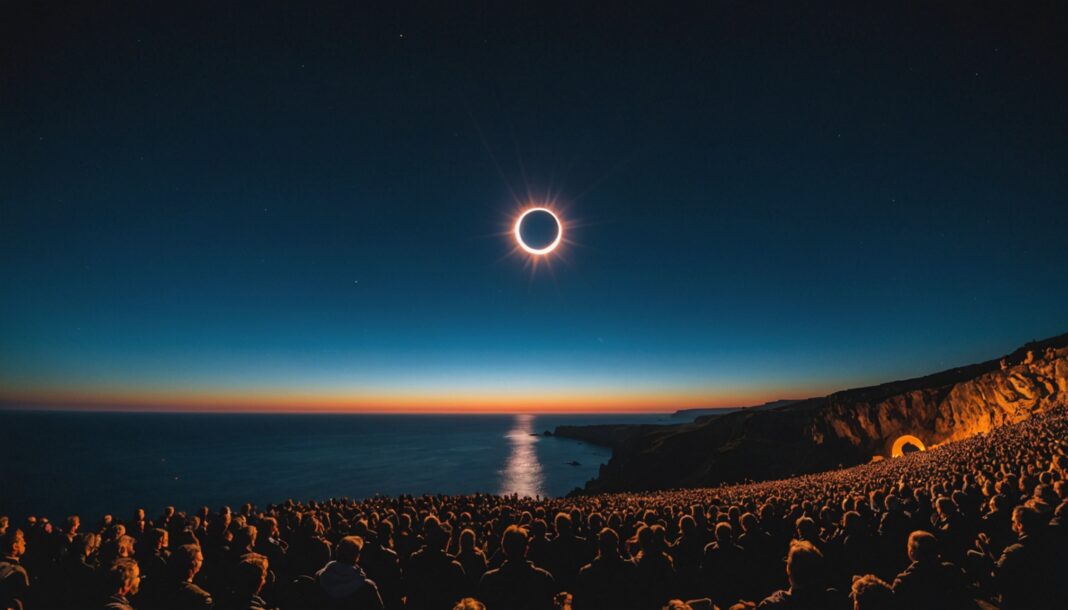

On August 12, 2026, the European sky put on a show the continent hadn't seen in nearly three decades: a total solar eclipse. Starting in a remote region of Siberia, the Moon's shadow swept across Greenland, Iceland, then northern Spain and a tiny tip of Portugal, before fading away over the Atlantic late in the evening.
A narrow but spectacular path of totality
The path of totality, just a few dozen kilometers wide, drew the attention of astronomers and travelers from around the world. In Spain, the maximum duration of total darkness reached 2 minutes and 18 seconds at the heart of the corridor, with about 1 minute 48 seconds in Burgos and just over a minute in Vitoria-Gasteiz, at the northern edge of the band. The Balearic Islands, Majorca in particular, also experienced the sky plunging into darkness late in the day.
In Iceland and Greenland, the phenomenon occurred in the late afternoon or early evening local time, while in Spain and the extreme northwest of Portugal, the sun disappeared shortly before sunset, producing particularly intense colors on the horizon.
France missed totality, but not the show
Although it wasn't on the path of totality, France didn't miss out entirely: the country witnessed a partial eclipse, especially pronounced in the southwest, where the solar disk was obscured to a striking degree. In Paris, the phenomenon began around 7:22 p.m., right at the end of the day. A whole segment of local and national news coverage followed the event, with crowds of observers equipped with certified eclipse glasses and special programs at observatories.
Why this eclipse matters for science
Beyond the spectacle, every total eclipse remains a rare opportunity for researchers to study the solar corona, the sun's thin outer atmosphere normally drowned out by the star's brightness. Several scientific expeditions had positioned themselves along the path of totality, in both Spain and Iceland, to collect data that is impossible to obtain outside those few minutes of darkness. The topic also ties into current science and technology news, spanning space observation and cutting-edge instrumentation.
The event also gave a boost to eclipse tourism: fully booked hotels, special flights, and organized excursions drew visitors from all over the world to northern Spain and Iceland, a phenomenon now well documented in the travel and tourism industry.
When will Europe see another total eclipse?
Eclipse enthusiasts won't have to wait as long as last time: Spain is once again on the path of two spectacular eclipses in the coming years, on August 2, 2027, and then on January 26, 2028. Plenty of time to start planning the next hunt for darkness in broad daylight.
Frequently Asked Questions
Why was this eclipse so rare in Europe?
The continent hadn't seen a path of totality cross its soil in nearly 26 years. The precise geometry between Earth, the Moon, and the sun only rarely lines up to produce a total eclipse visible from the same region.
How can you safely observe a solar eclipse?
It's essential to use glasses certified to the ISO 12312-2 standard or a certified solar filter for any optical instrument. Looking directly at the sun, even when partially eclipsed, risks irreversible eye damage.
When will the next total eclipse visible from Europe take place?
Spain will host two more notable eclipses, on August 2, 2027, and January 26, 2028, before other regions of the continent experience totality again in the following decades.
Sources
Jellyfish in the Channel: Why the Gravelines Nuclear Plant Had to Shut Down Its Reactors
The weekend of August 8-10, 2026 once again highlighted a little-known vulnerability of France's nuclear fleet: the proliferation of jellyfish in the English Channel. At the Gravelines nuclear plant in northern France, three reactors had to be shut down and…

PISA: Gap Between Advantaged and Disadvantaged Students Widens in France
On September 8, the OECD released the results of its PISA 2025 survey, conducted among more than 760,000 15-year-old students in 91 countries and regions. In France, the findings go beyond a simple drop in the rankings: it is above…
Record Heat in Spain: A Signal That Worries Climate Scientists
A new heat record has just been set in Spain. On Thursday, the Spanish weather agency Aemet recorded 45.7°C in El Granado, in western Andalusia — a figure that matches the previous record for the month of September, set in…
Gas Reserves in Europe: Why This Winter Looks Tense
Gas reserves in Europe are heading into the cold season in a far more fragile position than usual. According to data from Gas Infrastructure Europe (GIE), European Union storage facilities were only about 63% full at the end of August,…

Ebola in the Democratic Republic of Congo: Unprecedented Clinical Trial to Test New Vaccine
A turning point may be emerging in the fight against one of the worst Ebola outbreaks ever recorded. On October 23, 2026, in Bunia, in the Ituri province in the northeast of the Democratic Republic of the Congo (DRC), the…
Record Heat: July 2026 Confirmed Among the Hottest Months Ever Measured
Data from the European Copernicus service has just confirmed it: July 2026 ranks among the hottest months ever recorded worldwide since modern measurements began in 1850. The oceans, for their part, broke an all-time record for surface temperature. Beyond the…

A €9 Million Gold Treasure Discovered in the Wall of a Belgian Cellar
A €9 million gold treasure has just been uncovered in the wall of a cellar in Belgium. Coins, bars, and nuggets: the discovery, made by an 18-year-old worker in the middle of plumbing work, is the stuff of dreams. But…

2026 Commonwealth Games: In Glasgow, a Bet on a Leaner Model to Save Mega Sporting Events
Starting July 23, 2026, Glasgow is hosting an edition unlike any other. The 2026 Commonwealth Games run through August 2 in the Scottish metropolis with an unprecedented ambition: to prove that a major global sporting event can survive while costing…
This article was written with the help of artificial intelligence. Editorial policy