



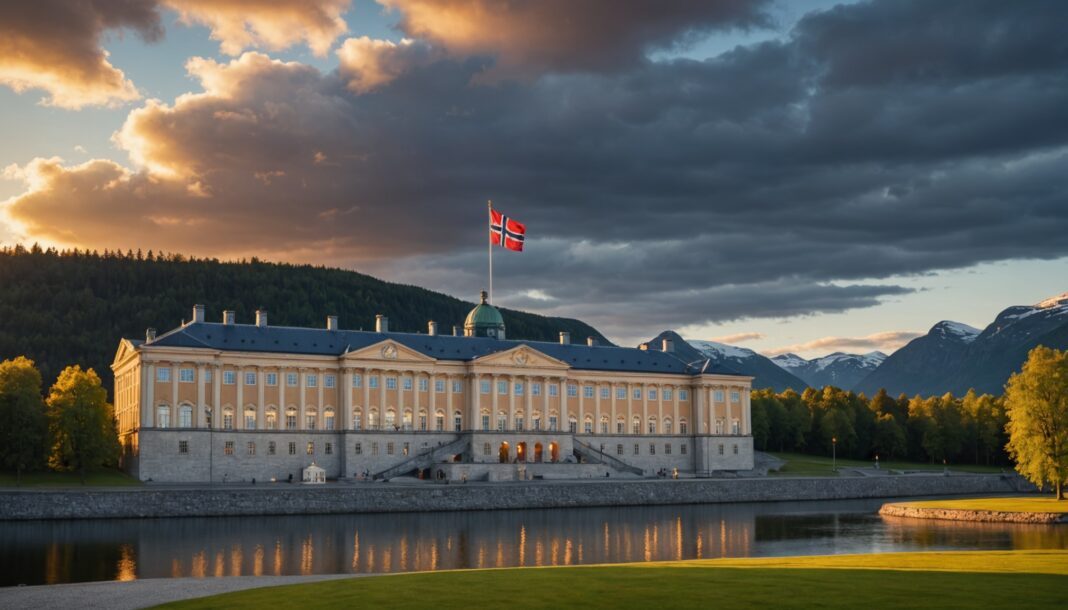

A page is turning in Scandinavia. Following the death of King Harald V of Norway, which occurred on August 28 at Rikshospitalet hospital in Oslo, his son automatically succeeds him on the throne under the name Haakon VIII. But contrary to what one might imagine, no coronation ceremony will seal this transfer of power. Here's an explanation of a custom that has now disappeared, yet remains very much alive in the public imagination.
A King Who Succeeds Without Being Crowned
Harald V died peacefully at the age of 89, after a 35-year reign that began in 1991. His son, previously the crown prince, became king the instant his father died, with no official act required to validate the succession. He has chosen to reign under the name Haakon VIII, in honor of the Norwegian royal lineage.
What often surprises the public is the complete absence of a coronation ceremony. The reason lies in the country's institutional history: the Norwegian Parliament, the Storting, abolished the constitutional requirement for a coronation back in 1908, deeming the practice too close to a monarchical rite from another era and poorly suited to the democratic spirit of the kingdom.
An Oath Before Parliament, Then a Religious Ceremony
Without a coronation, how does a Norwegian king nevertheless formalize his accession to the throne? The answer comes in two steps. First, an oath of allegiance to the Constitution, sworn directly before the members of the Storting: this moment is set for Tuesday, September 1. Then, in the coming months, a religious consecration ceremony is to be held at Nidaros Cathedral in Trondheim, the traditional site of major moments in the Norwegian monarchy for centuries.
Alongside the new sovereign, his wife Mette-Marit in turn becomes Queen of Norway. For several years now, the couple has embodied the image of a modernized Scandinavian monarchy, close to the people and committed to social causes.
Why This Succession Is Drawing Attention Far Beyond Norway
The passing of Harald V, who was among the longest-serving heads of state still in office in Europe, marks the end of a long cycle for the Scandinavian kingdom. This page is turning against a backdrop in which several major international events are shaping the news this fall, from diplomatic summits to technological breakthroughs reshaping the global balance.
European monarchies, like Norway's, must now navigate a demand for restraint and transparency very different from the pageantry of the past. In this climate, even the most spectacular symbols, whether a sports record broken by a humanoid robot or a rite from another time, are reinterpreted in light of contemporary expectations. The continent had, in fact, experienced another rare moment just days earlier with the return of a total solar eclipse observed from several European countries, a reminder that major events, whether celestial or institutional, still leave a lasting impression.
Key Takeaways
- Harald V died on August 28 at the age of 89, after a 35-year reign.
- His son became king immediately, under the name Haakon VIII.
- No coronation will take place: the practice was abolished in Norway in 1908.
- The new king will take his oath before the Storting on September 1.
- A religious ceremony at Nidaros Cathedral will follow in the coming months.
Frequently Asked Questions
Why isn't the King of Norway crowned?
Because the Norwegian Parliament abolished the constitutional requirement for a coronation in 1908, considering the ceremony incompatible with the democratic spirit of the kingdom.
When does Haakon VIII officially become king?
Legally, he became king the moment his father died, on August 28. He will then take his oath before Parliament on September 1.
What happens at Nidaros Cathedral?
A religious consecration ceremony, distinct from a coronation, will be held there in the months following the accession to the throne, in keeping with Norwegian monarchical tradition.
Sources
South Korean Container Ship Blazes New Arctic Trade Route
On Saturday, August 22, 2026, a container ship left the South Korean port of Busan bound for Europe. Nothing extraordinary at first glance, except that this ship will take neither the Suez Canal nor the Strait of Malacca: it will…

Ebola in the Democratic Republic of Congo: Unprecedented Clinical Trial to Test New Vaccine
A turning point may be emerging in the fight against one of the worst Ebola outbreaks ever recorded. On October 23, 2026, in Bunia, in the Ituri province in the northeast of the Democratic Republic of the Congo (DRC), the…
Jellyfish in the Channel: Why the Gravelines Nuclear Plant Had to Shut Down Its Reactors
The weekend of August 8-10, 2026 once again highlighted a little-known vulnerability of France's nuclear fleet: the proliferation of jellyfish in the English Channel. At the Gravelines nuclear plant in northern France, three reactors had to be shut down and…
International Criminal Court: Chad Joins the African Exodus
On July 27, 2026, N'Djamena officially announced its withdrawal from the Rome Statute, the founding treaty of the International Criminal Court (ICC). Chad thus becomes the fourth African country to walk away from the Hague-based court since 2025, following Burkina…
World's Longest Cargo Flight: Boeing 777 Links Scotland to Australia Nonstop
A world-record cargo flight has just been set across two hemispheres, and it's enough to make engineers and aviation enthusiasts alike feel dizzy. On August 4 and 5, 2026, a Boeing 777 Freighter operated by American airline National Airlines flew…
Asteroids: China and Japan Pull Off a Double Space Feat Three Days Apart
The first week of July 2026 will be remembered as a rare moment in space exploration: three days apart, two Asian probes successfully rendezvoused with some of the smallest asteroids ever approached. The Chinese probe Tianwen-2 settled in near Kamoʻoalewa,…

Panama Canal: Drought Forces Drastic Cut to Shipping Traffic
The Panama Canal will reduce its shipping traffic starting September 3, in the midst of a drought driven by the El Niño climate phenomenon. The canal authority (ACP) confirmed on Thursday that the number of ships allowed to transit each…

Exceptional El Niño: Why Meteorologists Worldwide Are Worried About the Coming Winter
World's major meteorological centers are unanimous: an exceptional El Niño episode is forming in the Pacific, and it could break every record observed since modern measurements began in 1950. According to the American agency NOAA and the World Meteorological Organization…
This article was written with the help of artificial intelligence. Editorial policy