


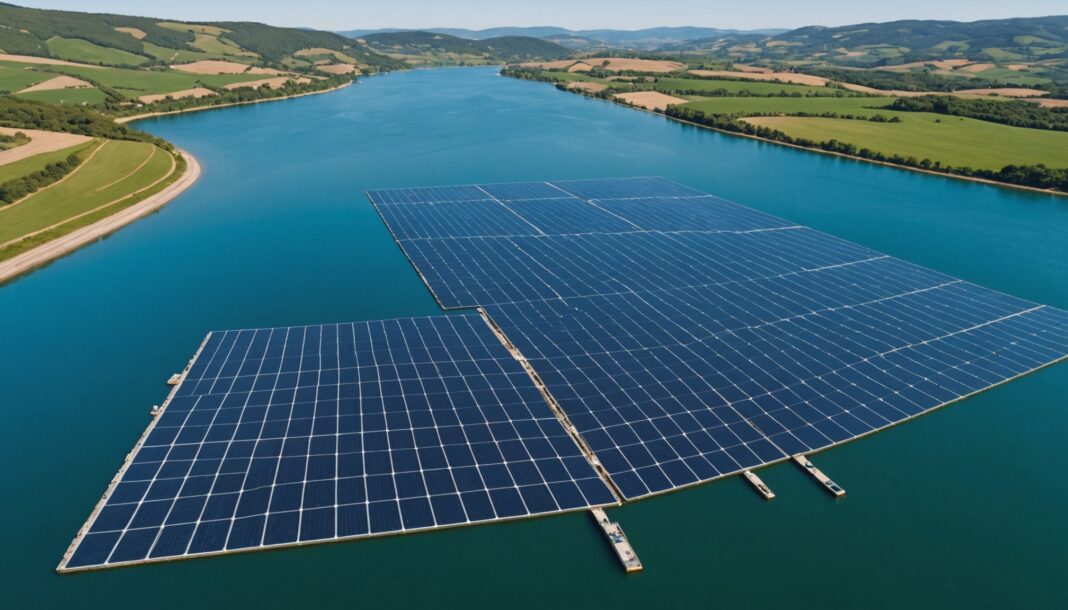

On dam lakes, flooded former quarries, and hillside reservoirs, a new generation of photovoltaic power plants is taking root directly on the surface of the water. Floating solar is gradually establishing itself as one of the most discreet solutions in France's energy transition, driven by several large-scale projects brought online in recent years.
An industry changing scale
Long confined to the margins, the industry crossed a symbolic threshold with the inauguration, in June 2025, of the Îlots Blandin plant in the Haute-Marne department. With more than 135,000 panels spread over 127 hectares for a capacity of 74.3 MWp, the installation is presented as the largest floating solar plant in Europe. It follows O'MEGA1, in Piolenc in the Vaucluse department, brought online as early as 2019 on the water body of a former quarry and expanded to 22 MWp after a 2022 extension.
Major utilities are also accelerating on hydroelectric dam reservoirs. EDF brought the Lazer plant online in the Hautes-Alpes department in 2023, with more than 50,000 panels for 20 MWp, and is now preparing the Cheylas project in the Isère department, where major construction work is set to begin in early 2026 for a commissioning planned for summer 2027. This future 44 MWp plant, with 70,000 panels, would produce around 60 GWh per year, enough to cover the electricity consumption of several tens of thousands of households.
Capacity has doubled in one year
According to data available at the end of 2024, the cumulative capacity of installed floating solar in France stood at around 210 MWp. 2025 marked a clear acceleration, with at least 92 MWp connected in the first half of the year alone, plus around 40 MWp of additional projects signed or under construction. This momentum is part of the targets set by France's third multiannual energy plan (PPE3), published on February 13, 2026, which aims for 48 GW of installed solar across all technologies by 2030, and up to 80 GW by 2035 — with no specific quota dedicated to floating solar at this stage.
France's Agency for Ecological Transition (Ademe) estimates that covering just 10% of France's artificial water bodies — quarries, reservoirs, industrial basins — could unlock a technical potential of up to 7 GW. Project developers present this resource as a way to install photovoltaic capacity without using agricultural or natural land, a significant argument as tensions over land use multiply around large ground-mounted solar farms.
Effects on water still under close watch
The deployment of these floating structures is not without consequences for aquatic environments. Initial observations from operating sites point to effects generally considered favorable: reduced evaporation, slight cooling of the water, and slower shoreline erosion. Conversely, the shade cast by the panels can reduce light, temperature, and oxygen levels in the water, with potential consequences for aquatic wildlife that largely depend on the size and layout of the project. That is why annual ecological monitoring of flora and fauna is now carried out at several sites, including O'MEGA1, to precisely document these impacts over time.
For local authorities and development project backers, the appeal of floating solar also lies in its relatively quick installation compared with a conventional ground-mounted farm, once environmental studies have been approved. On the financing side, several plants, such as O'MEGA1, have combined citizen-funded schemes with institutional investors, illustrating the growing appetite for this type of renewable asset.
Toward gradual mainstream adoption
While no specific national numerical target yet governs floating solar, several regional projects are under study on industrial reservoirs or former gravel pits, particularly in southern and eastern France. The coming years will show whether the industry can sustain its 2025 momentum, in a context where managing impacts on aquatic ecosystems will remain a decisive criterion for reviewing future project applications.
Frequently Asked Questions
What is floating solar?
It refers to photovoltaic panels installed on floats on the surface of artificial water bodies — dam lakes, flooded former quarries, or industrial basins — rather than on land or a rooftop.
What is the largest floating solar plant in France?
Îlots Blandin, in the Haute-Marne department, inaugurated in June 2025 with a capacity of 74.3 MWp, is presented as the largest installation of its kind in Europe.
Does floating solar impact aquatic environments?
Yes, both positive effects (less evaporation, slower erosion) and potentially negative ones (reduced light and oxygen levels beneath the floats) have been observed, which is why regular ecological monitoring is carried out at operating sites.
Sources

Drought in France: What a Water Restriction Order Changes
Watering your garden in the middle of the day, filling your pool, washing your car with a pressure washer: these everyday actions have become banned across nearly all of French territory this summer. After a spring that broke heat records…

Public Procurement: Environmental Criteria Become Mandatory, the End of Price-Only Bids
Starting August 21, 2026, a page turns for companies that respond to public tenders in France. The Climate and Resilience Law of 2021 fully takes effect on its public procurement provisions: it will no longer be possible for a public…

Greenwashing: The EU's Anti-Greenwashing Directive France Hasn't Transposed Yet
Since September 27, 2026, European Union member states have had to apply strict rules against greenwashing: this is the date the directive (EU) 2024/825, nicknamed EmpCo, entered into application. The problem: France has still not transposed the text into its…
Electric Taxis: Up to €5,500 in Aid for Drivers
Driving all day to transport passengers is one of the most intensive uses a car can get. To speed up the electric transition of this heavily used fleet, the French government has introduced a financial aid program dedicated to taxis,…
Climate in France: What the First Annual Impact Report Reveals (and How to Prepare)
France has just equipped itself with an official thermometer for the climate crisis. By publishing the first annual report on the impacts of climate change in France, the government has put precise figures on a reality that many are already…
Summer 2026: France and Europe Shatter Sunshine Records
Nearly uninterrupted sunshine, electric meters spinning in the best possible way: summer 2026 will go down in the continent's climate and energy history books. According to official data from Météo-France (the French national meteorological service), five Western European countries recorded,…

French Forests: Coverage Is Growing, but Their Health Is Declining Sharply
They gain ground every year, yet they have never been so fragile. The latest national forest inventory, published in early July 2026 by the IGN (France's national mapping and forestry information institute), paints a contrasting picture: French forests continue to…
Fonds Chaleur Suspended: What the Decision Means for Local Governments and Households
The French government has just suspended the Fonds Chaleur, the Ademe (France's agency for ecological transition) program that has funded renewable heating and cooling networks since 2009: biomass, geothermal, solar thermal, and industrial waste heat recovery. Announced on November 3…
This article was written with the help of artificial intelligence. Editorial policy