



So much for the dream of a mandatory plastic bottle deposit scheme across France. The government has just given up on requiring municipalities to adopt a national deposit system for plastic bottles, opting instead for an opt-in approach limited to willing local authorities. The announcement, made on September 4, 2026 by Mathieu Lefèvre, deputy minister for Ecological Transition, and Françoise Gatel, minister for Territorial Planning, puts an end to months of tug-of-war with local officials.
A Project Revived in May, Buried in September
Emmanuel Macron had nevertheless revived the issue in May 2026: the idea was to install collection points in supermarkets, with a few cents refunded for every bottle returned, modeled on systems already in place in Germany and Norway. But local authorities, responsible for selective collection and sorting, closed ranks against a measure they considered costly and redundant with their own systems, already built around reuse and the circular economy.
Room for Voluntary Action, with Priority for Poor Performers
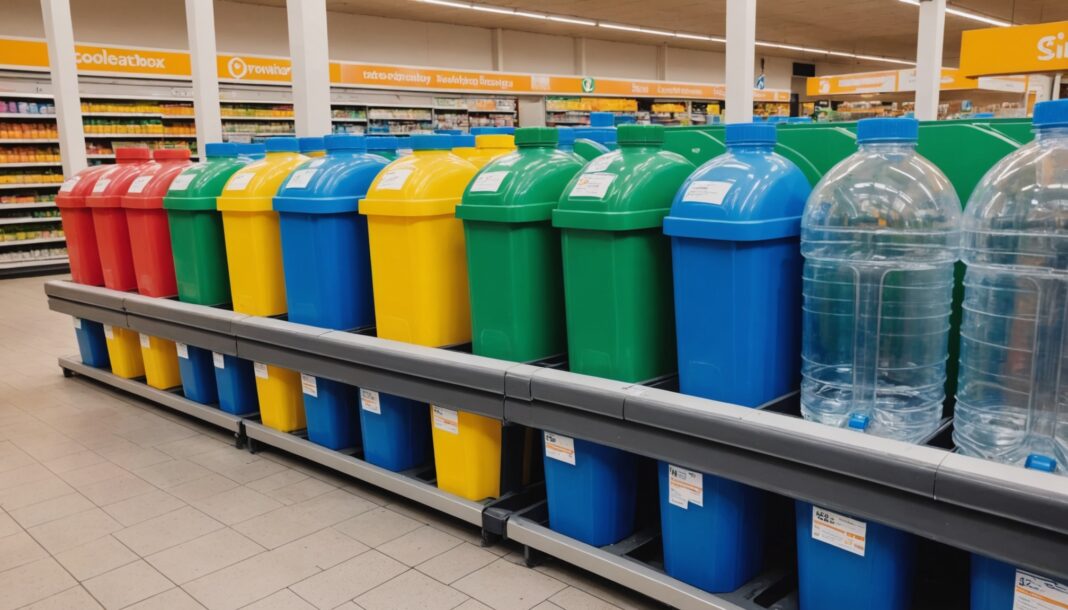
In practical terms, only municipalities that want to will now be able to set up collection points in partnership with retailers. Priority will go to areas where the collection rate is currently lowest. The government is betting on this targeted approach rather than a uniform system, focusing on mobilizing the areas lagging furthest behind rather than rolling the scheme out everywhere.
- Official announcement: September 4, 2026
- Lead ministers: Mathieu Lefèvre (Ecological Transition) and Françoise Gatel (Territorial Planning)
- Current plastic bottle collection rate in France: around 56%
- European Union target: 90% recycling of plastic bottles by 2029
- Expected gain from the voluntary system: 8 to 12 percentage points, bringing the rate to about 68% in 2029
France Still Far From the European Target
That's where the problem lies. The European Union has set a target of 90% collection of plastic bottles by 2029, while France currently plateaus at around 56%. According to projections, the voluntary system would only add 8 to 12 percentage points, bringing the national rate to roughly 68% in 2029 — far short of the 90% targeted at the European level, at a time when European circular economy directives are multiplying. The risk of a warning from Brussels can't be ruled out if the gap persists.
What This Actually Means for Consumers
For now, nothing changes for people in France: there's no obligation to return bottles to the supermarket, except in municipalities that choose to pilot the scheme. For the vast majority of households, sorting will still mean the standard yellow recycling bin. This battle over plastic is part of a broader push to fight waste, which also affects other sectors, as shown by the recent European regulation on unsold food.
Frequently Asked Questions
Is the plastic bottle deposit scheme becoming mandatory in France?
No. The government has dropped a mandatory national system in favor of a voluntary one, limited to municipalities that choose to set it up.
Why were local authorities opposed to the project?
They considered the deposit scheme costly and redundant with their own collection and selective sorting systems, already in place in their areas.
Will France reach the European Union's 90% recycling target?
Not with the voluntary approach alone: projections point to a rate of about 68% in 2029, far from the 90% target set by the European Union.
Sources
Fonds Chaleur Suspended: What the Decision Means for Local Governments and Households
The French government has just suspended the Fonds Chaleur, the Ademe (France's agency for ecological transition) program that has funded renewable heating and cooling networks since 2009: biomass, geothermal, solar thermal, and industrial waste heat recovery. Announced on November 3…

European Sustainable Development Week: The Spotlight on Responsible Eating
Starting September 18 and running through October 8, France is taking part in European Sustainable Development Week (SEDD), an annual highlight held across Europe. Local governments, businesses, schools, nonprofits, and ordinary citizens are invited to organize or join concrete actions…

Energy Renovation: CEE Grants Narrowed to Focus on the Leakiest Homes
Starting September 1, 2026, energy renovation grants are entering a new phase. Two decrees signed on August 17, 2026, and published in the Journal officiel (France's official gazette) on August 23, narrow the French Energy Savings Certificates (CEE) scheme around…

Climate in France: What the First Annual Impact Report Reveals (and How to Prepare)
France has just equipped itself with an official thermometer for the climate crisis. By publishing the first annual report on the impacts of climate change in France, the government has put precise figures on a reality that many are already…
Electric Taxis: Up to €5,500 in Aid for Drivers
Driving all day to transport passengers is one of the most intensive uses a car can get. To speed up the electric transition of this heavily used fleet, the French government has introduced a financial aid program dedicated to taxis,…
Floating Solar: France Accelerates on Its Lakes and Dams
On dam lakes, flooded former quarries, and hillside reservoirs, a new generation of photovoltaic power plants is taking root directly on the surface of the water. Floating solar is gradually establishing itself as one of the most discreet solutions in…

Public Procurement: Environmental Criteria Become Mandatory, the End of Price-Only Bids
Starting August 21, 2026, a page turns for companies that respond to public tenders in France. The Climate and Resilience Law of 2021 fully takes effect on its public procurement provisions: it will no longer be possible for a public…
Summer 2026: France and Europe Shatter Sunshine Records
Nearly uninterrupted sunshine, electric meters spinning in the best possible way: summer 2026 will go down in the continent's climate and energy history books. According to official data from Météo-France (the French national meteorological service), five Western European countries recorded,…
This article was written with the help of artificial intelligence. Editorial policy