




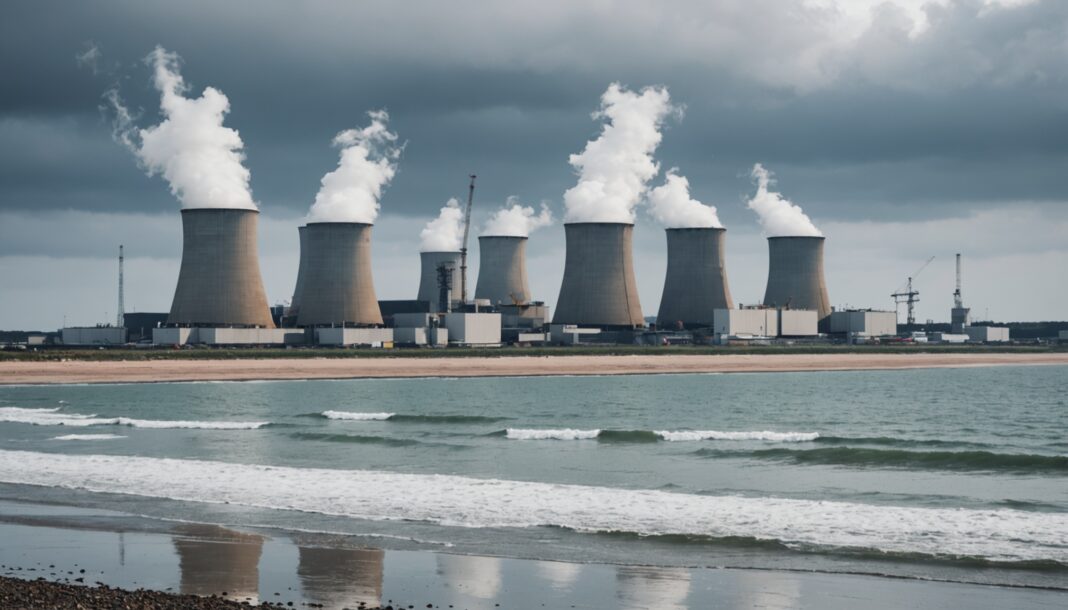

A decree published Saturday in the Journal Officiel (France's official gazette) authorizes EDF to begin preparatory work on the future EPR2 reactors at Gravelines, in northern France. It's a long-awaited step for the largest French nuclear project in decades, but one that many are already mistakenly confusing with the green light for construction itself.
What the Decree Actually Authorizes
The text grants EDF an environmental authorization to develop the site where the two future EPR2 units will be built. In practical terms, teams will be able to prepare the platforms, set up construction bases, relocate the site's rail terminal, and begin initial earthworks. The program also includes soil reinforcement, construction of a watertight enclosure beneath the footprint of the future buildings, and work on the water intake channel, which is essential for cooling the reactors. The decree also sets out requirements for water management, biodiversity preservation, and environmental monitoring of the construction site.
What the Decree Does Not Authorize — Yet
This is the point most often misunderstood: this environmental authorization does not amount to authorization to build the reactors. It does not allow construction to begin on the buildings intended to house nuclear materials or safety-related equipment. That next step will require a separate decree. More broadly, the final investment decision for the entire EPR2 program — six reactors organized into three pairs nationwide — is not expected until the end of 2026.
The Project by the Numbers
- Two reactors of 1,600 MW each will be added to the six 900 MW reactors already operating at the Gravelines site.
- EDF estimates the cost of the first three pairs of EPR2 reactors in the national program at 51.7 billion euros.
- Commissioning of the first pairs is expected between 2037 and 2044.
Why This Step Matters
Beyond its industrial significance, this project represents years of economic activity for the Dunkirk employment area and a real-world test for the French nuclear industry, which had not launched a project of this scale since the EPR at Flamanville. The timeline remains long, however: nearly twenty years could pass between today's preparatory work and the announced commissioning date.
This story fits into the broader energy policy decisions covered in politics and government decisions, alongside the transition debates discussed in ecology and climate and the industrial developments covered in science and technology.
Frequently Asked Questions
Does the decree already authorize construction of the EPR2 reactors at Gravelines?
No. This is an environmental authorization limited to preparatory work (earthworks, platforms, water intake channel). Construction of the nuclear buildings requires a separate construction authorization, which has not yet been granted.
How many EPR2 reactors are planned at Gravelines, and what will their power output be?
Two EPR2 reactors of 1,600 MW each are planned, in addition to the six 900 MW reactors already in operation at the site.
When will the new reactors at Gravelines go into service?
EDF is targeting commissioning of the first pairs in the EPR2 program between 2037 and 2044, pending the final investment decision expected by the end of 2026.
Sources
- Euronews — EDF authorised to prepare site for two new nuclear reactors at Gravelines plant
- Sud Radio — Nucléaire : feu vert au lancement des travaux préparatoires des EPR2 à Gravelines
- Le Singulier — Gravelines, le terrain des futurs réacteurs EPR2 se prépare

Pass Sport: Sports Club Enrollment Aid Drops but Opens to More Families
The Pass Sport is being renewed for the new season, but with a reduced amount: the aid drops from €70 to €50. In exchange, the program is being expanded to more families, with the return of children ages 6 to…
Second Simplification ‘Mega-Decree': What Changes for Local Governments
Published in the Journal officiel (France's official gazette) on July 28, 2026, the second “mega-decree” of simplification (Decree No. 2026-674 of July 27, 2026) continues a project launched in late 2025: easing the regulations that weigh on local governments and…

Animal Welfare: The Government's Plan to Better Regulate Sales and Breeding
Selling dogs and cats in pet stores, animal fairs, exotic pets (NAC, “new companion animals”): the French government has unveiled an action plan aimed at closing the gaps still left by the 2021 law against animal abuse. Animal welfare is…

Sick Leave: Duration of Work Leave Is Now Capped
Starting September 1, 2026, the duration of sick leave can no longer be freely set by the health professional who prescribes it. A decree published in the Official Journal (Journal officiel) now regulates the maximum length of an initial prescription…
Negative Electricity Prices: France Tightens Remote Shutdown Rules for Solar and Wind Power
A decree quietly published in the Journal Officiel (France's official gazette) is nonetheless about to change life for thousands of green electricity producers in France. Previously reserved for large installations, the obligation to shut down remotely in cases of negative…
Suspension of the Pension Reform: What Changes for You
The suspension of the 2023 pension reform took effect on September 1 of this year in France. Passed as part of the Social Security financing law, it freezes the increase in the legal retirement age and the required contribution period…

Vehicle Registration: Garages Must Now Renew Their SIV Authorization
Since August 1, professionals authorized to issue registration certificates must comply with significantly stricter rules. A decree has just overhauled the conditions for access to the vehicle registration system (SIV), with a clear objective: putting an end to years of…

Anti-Fast-Fashion Law: What's Changing for Clothing in France
France is becoming the first European country to adopt a law specifically targeting ultra-fast fashion. Enacted on July 8, 2026, after more than two years of parliamentary back-and-forth, the law is being phased in starting September 1: here's what's actually…
This article was written with the help of artificial intelligence. Editorial policy