

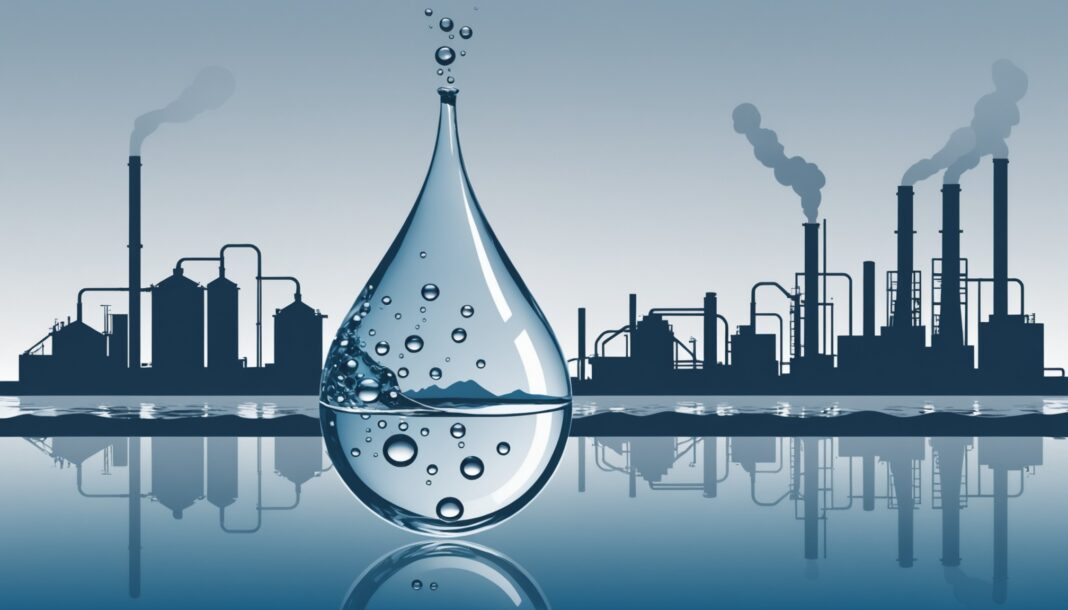

After more than a year of delay, the polluter-pays principle finally applies to PFAS discharges into water. Since September 1, 2026, industrial companies that dump these “forever chemicals” must pay a fee — a landmark measure in our environment and climate coverage, but one whose scale, numbers in hand, remains far below the scope of the problem.
What are PFAS, and why this fee?
PFAS encompass several thousand chemical substances that have been used for decades in industry — food packaging, waterproof textiles, firefighting foams, non-stick coatings. Nicknamed “forever chemicals” because they barely break down in the environment, they are now detected in the tap water of a large portion of France. Several scientific studies link them to risks for human health, a topic that overlaps with our health and medicine coverage.
Law No. 2025-188, passed in February 2025 to protect the population from the harmful effects of PFAS, already provided for this principle. It took the implementing decree, published after more than a year of delay, for it to actually take effect on September 1, 2026.
€100 for every 100 grams discharged
In practical terms, more than 200 industrial companies that discharge PFAS into water bodies must now pay a fee of €100 for every 100 grams of substances released. A reduction is planned for sites that install water treatment systems limiting these discharges at the source — a way of encouraging industrial companies to invest rather than simply pay.
This approach is part of a broader trend of holding economic actors accountable for their environmental impact, an issue that several industrial sectors must now factor into their business models.
A negligible yield compared to the real cost of pollution
The amount collected is nonetheless expected to be very limited. The most optimistic estimates point to €10 million in revenue in 2026, while France's General Inspectorate of Social Affairs puts the figure closer to €5 million per year. That number should be compared with the €2 billion a year that France's General Inspectorate of Finance deems necessary to clean up contaminated drinking water networks.
In other words, the polluter-pays fee will fund, at best, only a tiny fraction of the cleanup actually needed. This gap echoes one already seen on other issues related to environmental degradation in France, where the resources committed often struggle to keep pace with the scale of the findings.
Key takeaways
- Effective date: September 1, 2026, after more than a year of regulatory delay.
- Fee: €100 for every 100 grams of PFAS discharged into water.
- More than 200 industrial companies affected in France.
- Possible reduction for sites that install water treatment systems.
- Expected revenue: €5 to €10 million per year, compared with the €2 billion deemed necessary for cleanup.
On the ground, the concrete effects of this fee will be measured above all in the quality of the water supplied, an issue closely watched, including for its consequences on ecosystems already weakened by other forms of pollution.
Frequently Asked Questions
What is PFAS?
PFAS (per- and polyfluoroalkyl substances) are highly resistant industrial chemical compounds used notably in packaging, textiles, and firefighting foams. They break down extremely slowly in the environment, hence their nickname “forever chemicals.”
Who has to pay the new fee?
Industrial companies whose sites discharge PFAS into water bodies — more than 200 facilities in France, according to the authorities. The amount owed depends directly on the volume of substances discharged.
Will this fee be enough to clean up drinking water?
No, far from it. The expected revenue (€5 to €10 million per year) remains well below the €2 billion a year that France's General Inspectorate of Finance deems necessary to treat contaminated water networks.
Sources
France Info — Banque des Territoires — Juriguide
Plastic Bottle Deposit Scheme: Government Drops Mandatory National System
So much for the dream of a mandatory plastic bottle deposit scheme across France. The government has just given up on requiring municipalities to adopt a national deposit system for plastic bottles, opting instead for an opt-in approach limited to…

Drought in France: What a Water Restriction Order Changes
Watering your garden in the middle of the day, filling your pool, washing your car with a pressure washer: these everyday actions have become banned across nearly all of French territory this summer. After a spring that broke heat records…

French Forests: Coverage Is Growing, but Their Health Is Declining Sharply
They gain ground every year, yet they have never been so fragile. The latest national forest inventory, published in early July 2026 by the IGN (France's national mapping and forestry information institute), paints a contrasting picture: French forests continue to…
Fonds Chaleur Suspended: What the Decision Means for Local Governments and Households
The French government has just suspended the Fonds Chaleur, the Ademe (France's agency for ecological transition) program that has funded renewable heating and cooling networks since 2009: biomass, geothermal, solar thermal, and industrial waste heat recovery. Announced on November 3…
Greenwashing: The EU's Anti-Greenwashing Directive France Hasn't Transposed Yet
Since September 27, 2026, European Union member states have had to apply strict rules against greenwashing: this is the date the directive (EU) 2024/825, nicknamed EmpCo, entered into application. The problem: France has still not transposed the text into its…

Energy Renovation: CEE Grants Narrowed to Focus on the Leakiest Homes
Starting September 1, 2026, energy renovation grants are entering a new phase. Two decrees signed on August 17, 2026, and published in the Journal officiel (France's official gazette) on August 23, narrow the French Energy Savings Certificates (CEE) scheme around…
Floating Solar: France Accelerates on Its Lakes and Dams
On dam lakes, flooded former quarries, and hillside reservoirs, a new generation of photovoltaic power plants is taking root directly on the surface of the water. Floating solar is gradually establishing itself as one of the most discreet solutions in…

Public Procurement: Environmental Criteria Become Mandatory, the End of Price-Only Bids
Starting August 21, 2026, a page turns for companies that respond to public tenders in France. The Climate and Resilience Law of 2021 fully takes effect on its public procurement provisions: it will no longer be possible for a public…
This article was written with the help of artificial intelligence. Editorial policy