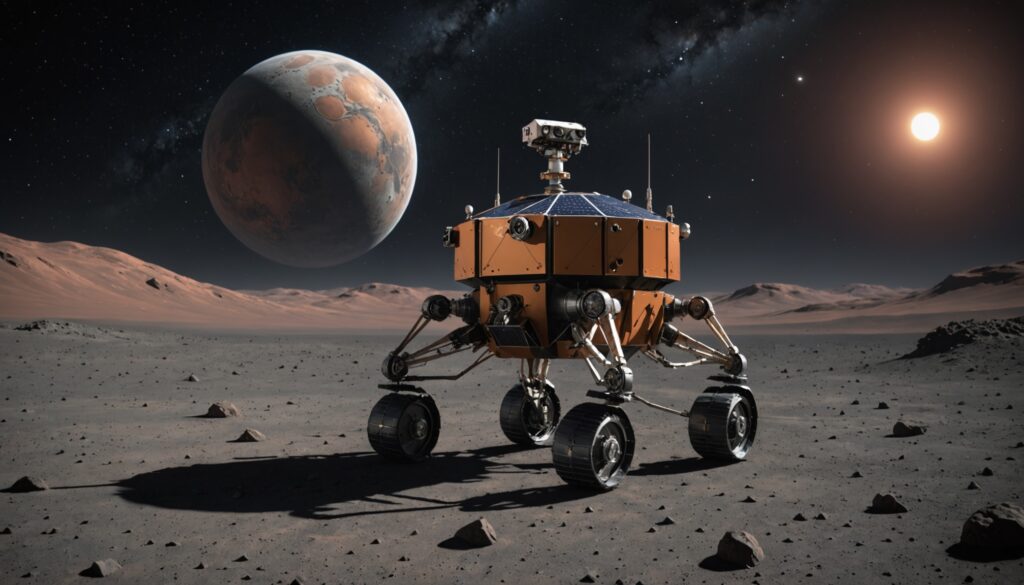




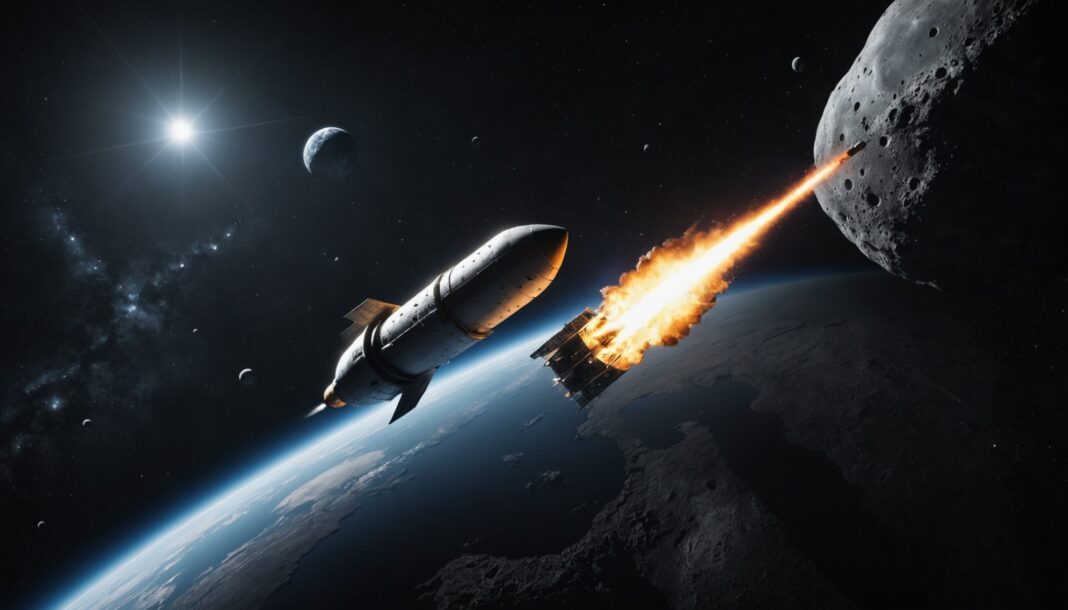

On August 5, 2026, a piece of SpaceX rocket will crash into the Moon. The object is nothing like an exploration spacecraft: it's a Falcon 9 upper stage turned space junk, adrift for eighteen months. Far from being a mere cosmic oddity, this impact offers scientists a rare opportunity to test their instruments and highlights a growing problem: the crowding of space, all the way to the vicinity of our satellite.
A Piece of Space Junk on a Collision Course
The object in question, catalogued as 2025-010D, is the upper stage of a Falcon 9 launched on January 15, 2025. That mission sent two private lunar landers on their way: Blue Ghost, from American company Firefly Aerospace, and Hakuto-R Mission 2, from Japanese company ispace. Once its payload was released, the stage — a cylinder about a dozen meters long and weighing roughly four tons — continued uncontrolled on a distant orbit.
American astronomer Bill Gray, known for his orbit-calculation software Project Pluto, established the trajectory leading to the collision. The impact is expected on August 5, 2026, around 6:35–6:45 a.m. Universal Time, or around 8:35–8:45 a.m. Paris time. The impact point is located near the Einstein crater, on the Moon's near side.
What Scientists Hope to Observe
The stage is expected to hit the surface at a speed estimated at around 8,700 km/h, nearly seven times the speed of sound. The energy released should produce a crater whose diameter, according to models, is estimated at between roughly fifteen and thirty meters. Astronomers are especially watching for two phenomena: the brief flash produced at the moment of impact and the plume of lunar dust thrown several kilometers above the surface.
There's also a methodological interest. By comparing the crater's actual position with their predictions, researchers will be able to refine their methods for locating impacts on the Moon. That expertise is valuable at a time when space agencies are preparing future lunar seismic stations capable of listening for tremors beneath the surface. A comparable impact observed in 2022, attributed to a former Chinese rocket stage, had already served as a training ground.
The Real Issue: Space Is Filling Up With Debris
Beyond the spectacle, the event highlights a growing concern. The increasing number of launches leaves behind thousands of defunct objects, from low orbits all the way to what's known as cislunar space, between Earth and the Moon. The latter, long empty, is becoming a corridor frequented by both public and private missions.
Unlike satellites in low orbit, these distant stages are neither continuously tracked nor easy to catalog. Their trajectory depends on subtle perturbations — solar radiation pressure, gravitational tugs — which make predictions difficult. This deliberately monitored impact is thus becoming a textbook case for better tracking an increasingly crowded space environment.
Why This Matters to Us
For the general public, this goes beyond astronomical curiosity. It raises the question of sustainable space management, an issue that connects with Earth-bound debates on waste and technological restraint. The lessons learned from this impact will shape how lunar missions are regulated going forward, at a time when traffic toward our satellite is intensifying. These topics overlap with our Digital – High Tech and Ecology and Climate sections, as well as with the Science and Technology section.
Frequently Asked Questions
Will It Be Possible to See the Impact From Earth?
Not with the naked eye or an amateur telescope: the flash will be too brief and too faint. Observation will rely on specialized instruments and, potentially, on probes in lunar orbit tasked with later photographing the new crater.
Does This Impact Pose Any Danger?
None to Earth. The Moon has no atmosphere or life, and it already bears countless craters. The energy released remains modest on the scale of our satellite; the only “damage” will be one more small crater.
Is This the First Time Human Debris Has Hit the Moon?
No. Several rocket stages and probes have already crashed there, whether intentionally or not. What's new here is the ability to observe the impact on a sunlit area and verify its location in advance.
Sources
- Phys.org — When a SpaceX rocket crashes into the moon, scientists will be watching
- BBC Sky at Night Magazine — Falcon 9 upper stage Moon impact
- Smithsonian Magazine — A SpaceX rocket part expected to smack into the Moon

Wi-Fi: Your Router Can Now Identify You Without a Camera, German Study Reveals
An ordinary Wi-Fi router, without a camera or any special sensor, can now be enough to identify a person with near 100 percent accuracy. That's the conclusion of a study conducted by the Karlsruhe Institute of Technology (KIT), in Germany,…
An Unexpected Comet Spotted by the Euclid Space Telescope
A telescope designed to photograph billions of distant galaxies wasn't supposed to cross paths with a visitor from our own solar system. Yet that's exactly what just happened to Euclid, the European Space Agency's (ESA) space telescope, which unexpectedly captured…
Perseids: Why the Night of August 12-13 Will Be Exceptional for Watching Shooting Stars
Every summer, the same question comes up among stargazing enthusiasts and casual onlookers alike: what's the best night to watch shooting stars? This year, the answer is particularly clear-cut. On the night of August 12-13, the sky will host the…

Temporal Photonic Crystal: Physicists Tame Light at Lightning Speed
What if light could be shaped, slowed down, or amplified in the blink of a trillionth of a second, without spending an ounce of extra energy? That's exactly what a French-German research team has just achieved, bringing together French laboratories…
A Muon Laser That Can See Through Concrete
An international team of physicists has achieved an unprecedented milestone in imaging dense materials. Using an ultra-powerful muon laser, researchers at the Extreme Light Infrastructure – Nuclear Physics (ELI-NP) facility in Romania managed to photograph an object hidden behind two…

Apple Ad With a Baby: Why Italy Demanded Its Removal
An Apple ad showing a very young child with an iPhone has just disappeared from a large billboard in Milan. The Apple brand had to pull the visual after an Italian public authority in charge of child protection intervened, reigniting…
Inouye Telescope Reveals Unprecedented Swirls on the Sun's Surface
The Sun has just given up a secret decades in the making. Thanks to the Daniel K. Inouye Solar Telescope, perched atop the Haleakalā volcano in Hawaii, an international team of astronomers has photographed thousands of tiny plasma vortices blanketing…

Labeling Deepfakes and AI Content: What's Now Mandatory in Europe
Since August 2, 2026, a new obligation stemming from the European regulation on artificial intelligence (the AI Act) has concretely applied to the digital daily life of French citizens: deepfakes and AI-generated content must now be labeled. A discreet regulatory…
This article was written with the help of artificial intelligence. Editorial policy