






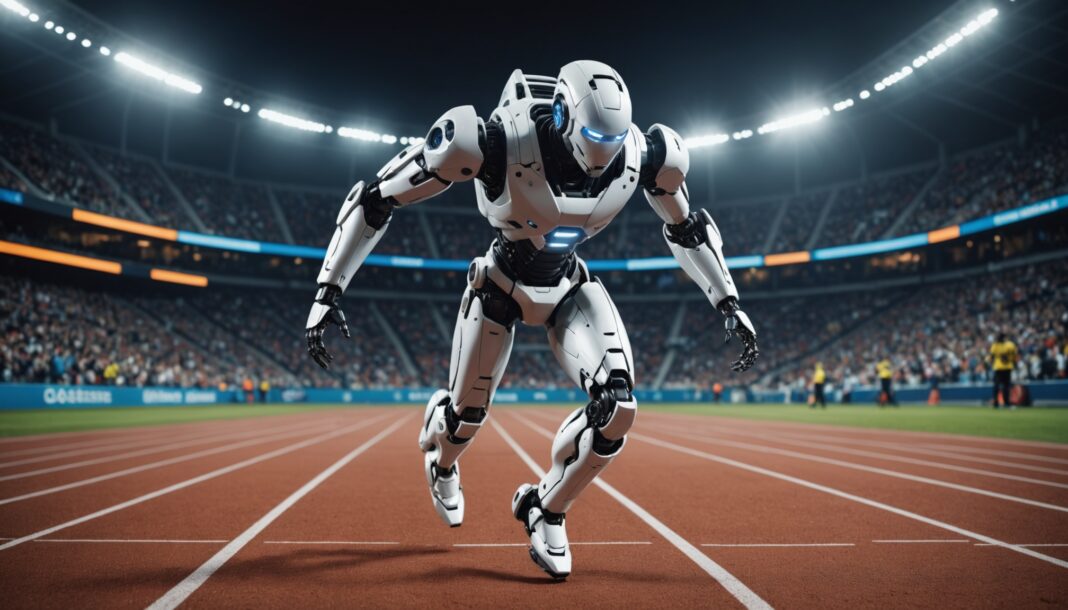

The Usain Bolt myth has just fallen — though not on a human track. On the weekend of August 22 and 23, 2026, in Beijing, a humanoid robot ran the 100 meters in 9.39 seconds, breaking the 9.58-second world record set by the Jamaican sprinter in Berlin in 2009. The feat took place at the World Humanoid Robot Games, an international competition entirely dedicated to human-sized robots.
A time that shatters the Bolt legend
The winning robot, named TienKung and designed by the Beijing Centre for Humanoid Robotics, covered the premier sprint distance in 9.39 seconds in the Beijing stadium nicknamed the “Ice Ribbon.” By comparison, no human has ever gone below 9.58 seconds, the time set by Usain Bolt at the 2009 World Championships. Videos of the race, widely shared on social media, show the competing robots hitting large landing mats and slowly tipping backward after crossing the finish line, still unable to brake like a human athlete.
A sprawling competition
The 2026 World Humanoid Robot Games are no small-scale demonstration: the event brought together 666 teams and no fewer than 2,056 robots from 16 different countries. An extra-large format that illustrates how much this discipline has grown in just two editions.
- 666 participating teams
- 2,056 humanoid robots entered
- 16 countries represented
- Event held at Beijing's “Ice Ribbon” stadium
Lightning-fast progress in just one year
What impresses observers of the robotics and high-tech sector most is the sheer speed of progress: the winning time at the 2025 edition stood at 21.50 seconds, more than twice as slow as this year's performance. The organizers themselves note that the robots entered have become “twice as fast in just one year,” a rate of progress rarely seen in any sporting discipline, human or robotic.
Why it's about much more than a sporting feat
Beyond the spectacular headline, this race also serves as a showcase for a booming industry. Investment bank Morgan Stanley estimates that the global humanoid robot market could reach $5 trillion by 2050, with roughly 302.3 million units in use in China alone by that time. For readers curious about technology and digital life, these public competitions function above all as an accelerator for research and development, with every broken record validating real-world advances in balance, actuation, and motor control. Fans of geek news should therefore expect to see this kind of announcement return regularly in the months ahead.
Frequently Asked Questions
Can a robot really run faster than a human today?
Yes, in this specific event: the robot TienKung completed the 100 meters in 9.39 seconds, a time faster than the 9.58-second human record held by Usain Bolt since 2009.
What are the World Humanoid Robot Games?
It's an international competition held in Beijing that brings together humanoid robots across several sporting disciplines, with the 2026 edition featuring no fewer than 666 teams and 2,056 robots from 16 countries.
Does this performance matter beyond the spectacle?
Yes: these competitions serve as a full-scale testing ground for the balance and motor-control technologies of humanoid robots, a sector Morgan Stanley values at a potential $5 trillion by 2050.
Sources
- Euronews — Chinese humanoid robot beats Bolt's 100 metre world record time
- Bloomberg — Humanoid robot beats Usain Bolt's 100m world record in Beijing
- Al Jazeera — Usain Bolt's 100m record broken at World Humanoid Robot Games

France 2030: The Tech Start-Ups Rewarded by the French State
On September 16, 2026, in Paris, the French government honored 109 winners at the France 2030 innovation competition ceremony, in the presence of Anne Le Hénanff, Minister for Artificial Intelligence and Digital Affairs, and Bruno Bonnell, Secretary General for Investment.…

Apophis 2029: The Asteroid That Will Pass Closer to Earth Than Its Satellites
On April 13, 2029, a 450-meter-long space rock will pass closer to Earth than some of our own satellites. Its name: Apophis. No panic, no science fiction — NASA has calculated its trajectory down to the kilometer, and the flyby…

AI-Designed Vaccine Achieves Unprecedented Milestone in Humans
What if an algorithm, alone, had designed the molecule capable of protecting us from a future pandemic? That's exactly what has just happened at the University of Cambridge. A universal vaccine against coronaviruses, designed from start to finish by artificial…

Hydrogen Turbine: Electricity Generated by Controlled Explosions
What if we could generate electricity from small, perfectly controlled explosions, with no mechanical compressor at all? That's the challenge taken on by German engineers at the Karlsruhe Institute of Technology (KIT), who have just run a new kind of…

Labeling Deepfakes and AI Content: What's Now Mandatory in Europe
Since August 2, 2026, a new obligation stemming from the European regulation on artificial intelligence (the AI Act) has concretely applied to the digital daily life of French citizens: deepfakes and AI-generated content must now be labeled. A discreet regulatory…

Nvidia Buys Hugging Face in 2026: What Changes for Open Source AI
American graphics chip maker Nvidia officially announced in early September 2026 the acquisition of Hugging Face, the French-American platform that in just a few years became the world reference for open source artificial intelligence. The amount of the deal, confirmed…

An Unexpected Comet Spotted by the Euclid Space Telescope
A telescope designed to photograph billions of distant galaxies wasn't supposed to cross paths with a visitor from our own solar system. Yet that's exactly what just happened to Euclid, the European Space Agency's (ESA) space telescope, which unexpectedly captured…

On August 5, 2026, a SpaceX Rocket Stage Will Hit the Moon: What Scientists Will Observe
On August 5, 2026, a piece of SpaceX rocket will crash into the Moon. The object is nothing like an exploration spacecraft: it's a Falcon 9 upper stage turned space junk, adrift for eighteen months. Far from being a mere…
This article was written with the help of artificial intelligence. Editorial policy



.)