



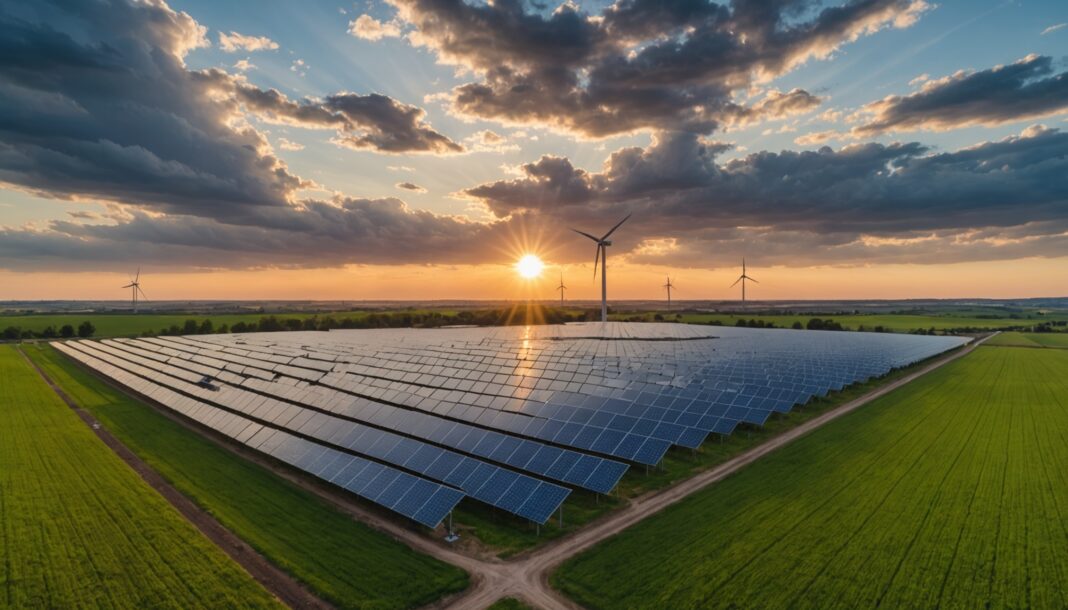

A decree quietly published in the Journal Officiel (France's official gazette) is nonetheless about to change life for thousands of green electricity producers in France. Previously reserved for large installations, the obligation to shut down remotely in cases of negative prices will now apply to much smaller solar farms and wind parks. Here's an explanation of a technical measure with very real consequences.
A Threshold Cut Tenfold in Two Stages
The text, dated July 20, 2026, and published in the Journal Officiel a few days later, lowers the threshold for the curtailment mechanism — the remote shutdown of renewable installations — from 10 megawatts (MW) to 1 MW. In practical terms, grid operators will be able to automatically cut production at a much wider range of solar and onshore wind installations as soon as electricity prices turn negative on the wholesale market.
The shift will happen in two stages, to give operators time to adapt their equipment:
- Starting December 1, 2026: photovoltaic installations above 5 MWp and other renewable installations above 5 MW will be affected.
- Starting March 1, 2027: the mechanism will extend to installations between 1 and 5 MW, including many mid-sized solar farms and parking lot solar canopies.
Why This Measure Now?
The decision stems from the growing number of negative price episodes on the French electricity market. In the first half of 2026, France recorded 407 hours of negative prices, nearly 10 percent of the time — compared to 513 hours for all of 2025 and just 147 hours in 2023. These episodes occur when electricity production, particularly solar output at midday, far exceeds demand, sometimes forcing the grid to pay to offload the surplus.
By lowering the trigger threshold, the French government is seeking to limit the costs that these negative prices place on the electricity system, while also avoiding overloading a grid that is already strained during periods of high renewable output. This change notably brings France closer to practices already in place in several neighboring European countries, where lower thresholds have existed for longer.
What Changes for Producers
For operators of medium-sized solar farms or wind parks, the new rule means investing in remote control and communication systems compatible with the grid operator's requirements. Installations under a public contract (feed-in tariff or market premium) are the first to be affected.
On the economic side, shutdown periods don't necessarily mean an outright loss for every producer: the market premium mechanism provides for compensation in certain cases. But the increasing frequency of shutdowns, even when compensated, is forcing operators to rethink their profitability models, especially for projects still in the planning stage.
Frequently Asked Questions
What Is a Negative Electricity Price?
A negative price occurs when the supply of electricity far exceeds demand on the wholesale market, typically at midday when strong combined solar and wind output coincides with low demand. Producers may then have to pay to feed their electricity into the grid rather than being paid for it.
Are All Solar Installations Affected by This New Threshold?
No. Only photovoltaic and onshore wind installations under a public support contract (feed-in tariff or market premium) that exceed the capacity thresholds set by the timeline are subject to the remote shutdown obligation.
Will This Measure Slow the Development of Renewable Energy in France?
Nothing suggests that at this stage: the measure is primarily aimed at better managing the electricity grid in the face of a growing number of negative price episodes, a phenomenon directly linked to the rapid growth of the renewable energy fleet. It comes with compensation mechanisms designed to limit the economic impact on operators.
This regulatory shift illustrates a broader challenge: as France's solar and wind fleet grows, fine-grained grid management is becoming just as important as building new capacity. To learn more about the issues surrounding the energy transition, check out our Ecology and Climate section, or for the economic implications for investors, our Finance – Money and Investment section. The remote control systems that make this measure possible fall under the technologies covered in our Digital – High Tech section.
Sources
Telemarketing Calls: What the New Ban Changes
No more intrusive calls at dinnertime to sell home insulation or a new cell phone plan: since August 11, 2026, non-consensual telemarketing has been banned in France, across all sectors. This new law, stemming from a bill passed on June…

Animal Welfare: The Government's Plan to Better Regulate Sales and Breeding
Selling dogs and cats in pet stores, animal fairs, exotic pets (NAC, “new companion animals”): the French government has unveiled an action plan aimed at closing the gaps still left by the 2021 law against animal abuse. Animal welfare is…

EPR2 Reactors at Gravelines: Government Gives Green Light to Preparatory Work
A decree published Saturday in the Journal Officiel (France's official gazette) authorizes EDF to begin preparatory work on the future EPR2 reactors at Gravelines, in northern France. It's a long-awaited step for the largest French nuclear project in decades, but…
Social Leasing 2026: Electric Cars Return From €94/Month — Who Qualifies?
After a 2024 edition that launched in a rush and was then put on hold, social leasing makes its big comeback on July 16, 2026. This public program lets lower-income households in France lease a new electric car for a…

Foreign Investments in Strategic Companies: Control Threshold Lowered to 10%
Since August 2, 2026, a new decree changes the game for foreign investments in French companies deemed strategic. The government has lowered, from 25% to 10%, the threshold beyond which a non-European investor must obtain authorization before taking a stake…

Pass Sport: Sports Club Enrollment Aid Drops but Opens to More Families
The Pass Sport is being renewed for the new season, but with a reduced amount: the aid drops from €70 to €50. In exchange, the program is being expanded to more families, with the return of children ages 6 to…

Cell Phones Banned in High School: What the New Law Says
It's official: starting this school year, the cell phone ban is extending to high schools. After nursery schools, elementary schools, and middle schools, it's now the turn of upper secondary institutions to shift to a framework where smartphones no longer…

Cell Phones Banned in High School: What Actually Changes
Since the start of the school year, the cell phone has been banned in high schools in France, under terms that each school must now spell out for itself. The measure, already in place in middle schools since 2018, is…
This article was written with the help of artificial intelligence. Editorial policy