



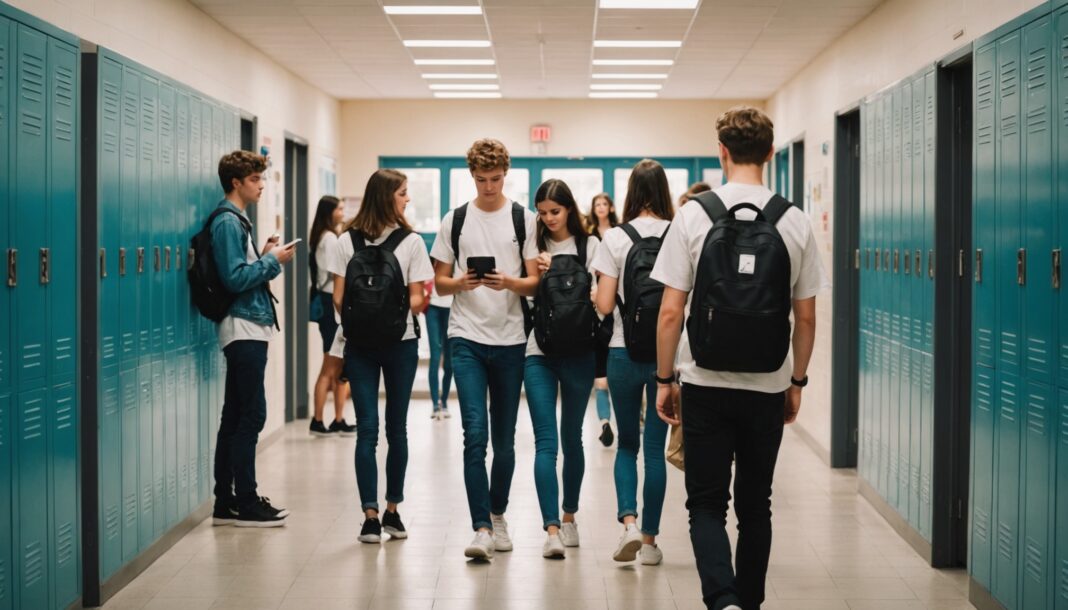

It's official: starting this school year, the cell phone ban is extending to high schools. After nursery schools, elementary schools, and middle schools, it's now the turn of upper secondary institutions to shift to a framework where smartphones no longer have a place during the school day, except under limited exceptions. Here's what this new law, passed on July 21, 2026, actually changes.
What exactly the law says
The text amends the French Education Code to extend to high schools a rule already applied earlier in schooling: the use of a mobile phone or any other connected device is now banned during school hours, including during breaks and between classes. In practice, students may no longer check or even take out their phones on school grounds, except in an explicitly authorized educational context approved by a teacher.
What happens if a student doesn't follow the rule?
- The Education Code provides for confiscation of the device in cases of non-compliance.
- The exact details (length of confiscation, graduated penalties) are set by each school's internal rules, which retain some discretion.
- Exceptions exist: supervised educational uses, administrative necessities, and the operation of the library (CDI), the cafeteria, or boarding facilities.
Why this measure now
The government justifies the extension with screen-exposure data it considers worrying among teenagers: a 2025 study put the time spent in front of a screen by 15-to-19-year-olds at more than five hours a day. Beyond mere eye strain or sleep problems, authorities point to effects on classroom concentration and social isolation, as well as increased exposure to misinformation and cyberbullying — issues already well documented when it comes to teenagers' health and digital lives.
Implementation still left to individual schools
Unlike a single, rigid ban, the law gives middle and high schools real latitude to organize daily life: some opt for locked lockers at the entrance, others for simple storage pouches in the classroom. This flexibility, already well established in middle schools for several years, is meant to allow a smooth transition into high school, where digital uses (research, note-taking, educational apps) are actually more common than in middle school. Legally speaking, the measure is part of a broader movement to regulate minors' digital use, with several recent texts falling under digital law and online child protection.
For families, the issue goes beyond the classroom: the question of teenagers' relationship with screens and the internet in daily life remains largely unresolved outside school hours, where no national rule applies.
Frequently Asked Questions
When does the ban take effect in high schools?
The measure takes effect starting with the 2026 school year, following the law's adoption on July 21, 2026.
Can a student keep their phone turned on in their bag?
The exact rules depend on each school's internal regulations: some high schools require phones to be fully turned off, while others allow a phone to be off and put away, as long as it isn't used during school hours.
Are there any exceptions to this ban?
Yes, exceptions are provided for supervised educational use approved by a teacher, as well as for certain needs related to the library (CDI), school meals, or boarding facilities.
Sources
French Ministry of National Education — Cell phone ban from elementary school to high school
L'Étudiant — How the ban will be implemented at the start of the school year
Banque des Territoires — Macron confirms the ban starting in the 2026 school year

Rupture Conventionnelle: Unemployment Benefit Duration Reduced Starting This Fall
The fall of 2026 brings a concrete financial change for tens of thousands of employees each year: starting September 1, 2026, the maximum duration of unemployment benefits after an individual rupture conventionnelle (a mutually agreed contract termination in France) decreases…

Second Simplification ‘Mega-Decree': What Changes for Local Governments
Published in the Journal officiel (France's official gazette) on July 28, 2026, the second “mega-decree” of simplification (Decree No. 2026-674 of July 27, 2026) continues a project launched in late 2025: easing the regulations that weigh on local governments and…
Telemarketing Calls: What the New Ban Changes
No more intrusive calls at dinnertime to sell home insulation or a new cell phone plan: since August 11, 2026, non-consensual telemarketing has been banned in France, across all sectors. This new law, stemming from a bill passed on June…

VTC Drivers: The Exam Becomes Mandatory as the Government Closes the Equivalency Path
A new decree is reshuffling the rules of access to the profession of VTC (chauffeur-driven vehicle for hire) and VMDTR driver in France. Published on August 11, 2026, the text simply eliminates the so-called “equivalency path,” which until now allowed…

August 1, 2026: What's Changing for Your Budget (Savings, Electricity, Back-to-School)
As at the start of every month, August 1, 2026 brings a series of changes that directly affect household budgets. Better-paying savings, a higher electricity bill, a slight dip in gas prices, and the payment of the back-to-school allowance: here…

Pass Sport: Sports Club Enrollment Aid Drops but Opens to More Families
The Pass Sport is being renewed for the new season, but with a reduced amount: the aid drops from €70 to €50. In exchange, the program is being expanded to more families, with the return of children ages 6 to…

Animal Welfare: The Government's Plan to Better Regulate Sales and Breeding
Selling dogs and cats in pet stores, animal fairs, exotic pets (NAC, “new companion animals”): the French government has unveiled an action plan aimed at closing the gaps still left by the 2021 law against animal abuse. Animal welfare is…

Foreign Investments in Strategic Companies: Control Threshold Lowered to 10%
Since August 2, 2026, a new decree changes the game for foreign investments in French companies deemed strategic. The government has lowered, from 25% to 10%, the threshold beyond which a non-European investor must obtain authorization before taking a stake…
This article was written with the help of artificial intelligence. Editorial policy