
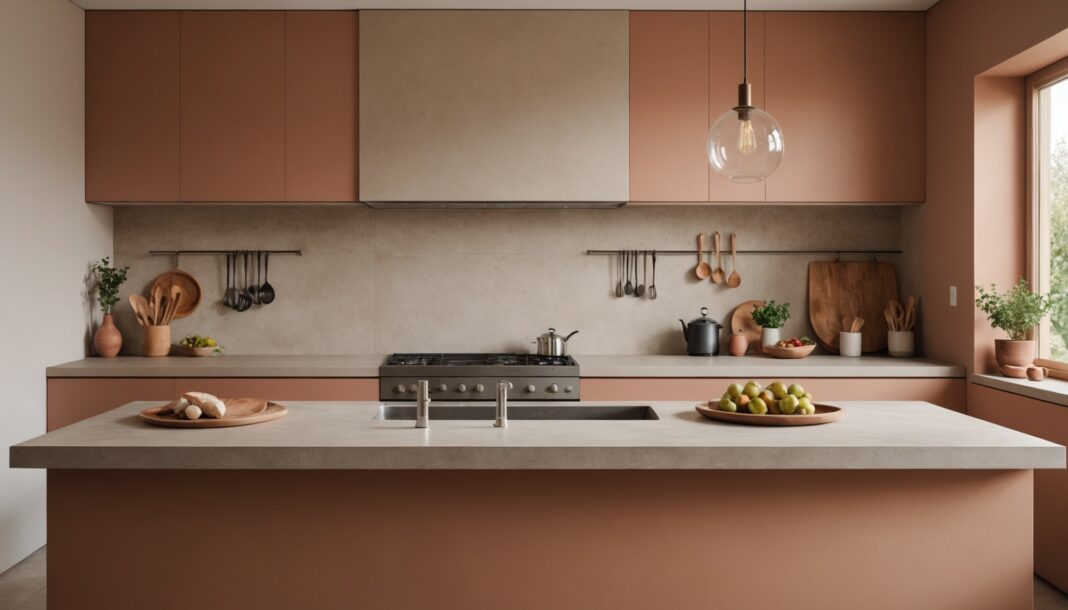

In French kitchens, a material from Spain is upending a habit that's decades old. Microcement is gaining ground over traditional tile, driven by a simple demand: putting an end to grout lines that turn black and complicate everyday upkeep. This continuous mineral coating is steadily becoming the go-to alternative for kitchen backsplashes and floors.
Why Tile Is Losing Ground
For a long time, tile protected kitchen walls from grease splatters and water. But its porous grout lines are also its main drawback: they trap dirt, darken over time, and require tedious tile-by-tile cleaning. It's precisely this pain point that microcement capitalizes on, with several construction professionals describing it as the solution that's “dethroning” tile in kitchen renovation projects.
This finding echoes a broader trend already seen across the industry: the search for natural materials and understated finishes continues to shape renovation choices among French households.
A Seamless Coating, Close to Polished Concrete
Microcement combines cement, resins, and specific additives to form a smooth, uniform surface applied directly over the existing base. The result is a continuous surface with no visual breaks, which radically simplifies daily cleaning compared to a mosaic of grouted tiles.
It isn't the only material benefiting from this shift. According to industry professionals, three families of surfacing now share the favor of kitchen designers:
- Microcement, applied in a thin, continuous layer with no visible grout lines;
- Large-format porcelain stoneware, whose oversized slabs keep cut lines to a minimum;
- Rigid SPC vinyl, favored for its controlled cost and quick installation.
For backsplashes, the trend also comes in large-format tiles imitating marble or concrete, as well as refined metals or custom glass — a way to keep a protective covering while cutting down on the number of grout lines.
What This Means for a Renovation Project
Unlike a classic tile removal job, microcement can often be applied without major demolition work, directly over a base in good condition. That argument appeals to households looking to modernize their kitchen without weeks of construction. In this respect, it echoes a dynamic already at work in furniture design, where the search for faster, less costly solutions is reshaping consumer habits.
Price, however, remains a point of caution: installing microcement, which requires specific expertise, generally costs more than entry-level tile. Before getting started, professionals recommend comparing several quotes and checking the compatibility of the existing base, especially in the case of old, damaged tile.
Aesthetically, this choice falls in line with current decor trends, which favor clean lines and mineral-looking materials over busy patterns.
Frequently Asked Questions
Can microcement be applied directly over existing tile?
Yes, in most cases, provided the base is stable and in good condition. This is precisely what makes microcement appealing compared to a full tile removal, which takes longer and costs more.
Is microcement more expensive than tile?
Generally, yes: installation requires specific expertise that affects the price, especially compared to entry-level tile. The cost varies significantly depending on the surface area and the condition of the base.
What are the other alternatives to kitchen tile?
Large-format porcelain stoneware and rigid SPC vinyl are among the solutions most cited by professionals, alongside microcement, each suited to a different budget and use.
Sources
2026 Decor Trends: Warm Minimalism and Cloud Dancer White Are Warming Up Our Homes
Forget all-white, icy interiors reminiscent of a waiting room. The 2026 decor trends tell a different story: one of interiors that slow down, warm up, and finally embrace their imperfections. The clearest signal came from Pantone, which crowned Cloud Dancer…
Paris Design Week: Design Returns to Paris in September
Paris Design Week is back from September 10 to 19 in the French capital. For ten days, nearly 600 designers and creators will take over roughly 400 iconic venues across Paris, including four national monuments, for this new edition built…
France Design Week: Design Takes Over the Regions to Tackle Major Challenges
From September 18 to 30, France Design Week brings design to the heart of France's regions, well beyond the usual Paris trade shows. Led by the association APCI – Promotion du design, this seventh edition brings together more than 600…
Secondhand Furniture: Why the Circular Economy Is Taking Hold in French Design
The mismatched sofa or thrifted dresser is no longer a stopgap: it has become the heart of a new, structured industry. In France, secondhand and upcycled furniture is now establishing itself as a market segment in its own right, driven…
Furniture in France: Rentals and Secondhand Are Reshaping the Market
The furniture industry is going through its third consecutive year of decline in France, but behind this slowdown lies a deeper transformation: long-term rentals, trade-ins, and organized secondhand sales are gradually becoming part of consumer buying habits. According to data…
Dining Room: The New Trends Transforming This Everyday Space
Gone is the big, fixed piece of furniture reserved for Sunday meals: the dining room is becoming a hybrid space in French homes, somewhere between a home office, a homework corner, and an entertaining area. This shift in how the…
Free Decor Diagnosis: Maisons du Monde and Rhinov Judge Your Living Room in One Click
A selfie of your living room, and the algorithm tells you everything that's wrong : that's the — slightly bold — promise of the new free decor diagnosis launched by Maisons du Monde and its subsidiary Rhinov. No more wasting hours…
Furniture Environmental Label: How to Read It and Why It's Coming
An environmental score will soon accompany furniture sold in France. Sofas, armchairs, beds, tables, and chairs will be the first affected by this label, designed to help buyers compare a piece of furniture's ecological impact before checking out. Here's how…
This article was written with the help of artificial intelligence. Editorial policy