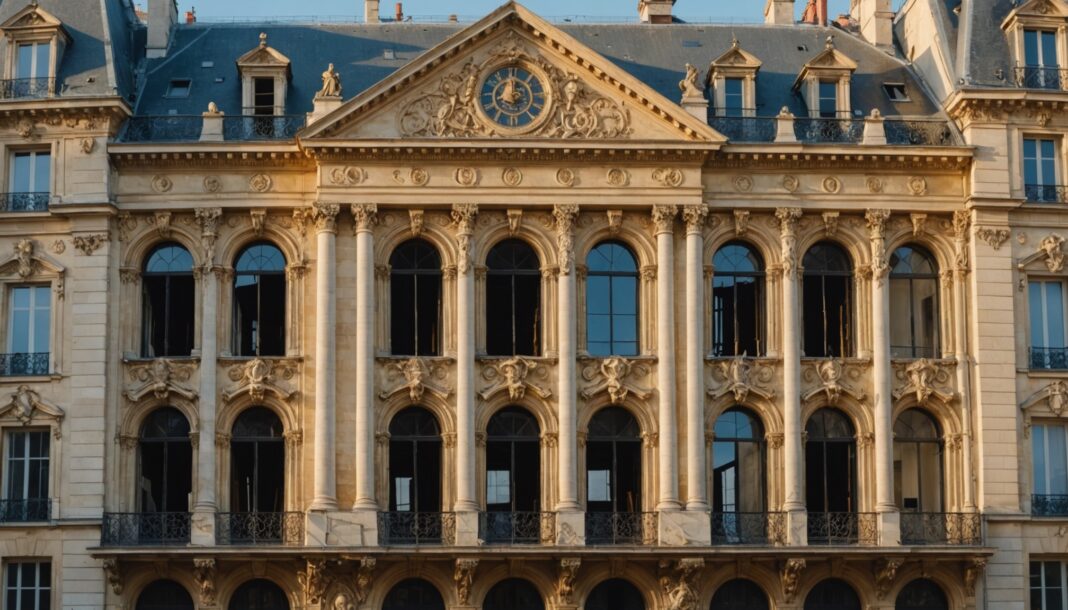

Can a public building become a historic monument within just a few days of a disaster? That is exactly what just happened in Limoges, where the city hall, largely destroyed by a fire on October 17, was placed under emergency heritage protection — known in France as an “instance de classement” — by the Ministry of Culture on November 2. Beyond the news story itself, this little-known procedure shows how the French government can urgently freeze protection for a threatened building, and why the bill for rebuilding it doesn't fall on the local authority alone.
What happened in Limoges?
Opened in 1883, the Limoges city hall was ravaged by an arson fire on the sidelines of a demonstration. The damage affected both the structure and the interior decor: moldings, woodwork, and glasswork. In the days that followed, a 3D survey of the spaces was carried out to preserve an exact record of the decorative elements before any securing work began.
What is an “instance de classement”?
This is the tool the French government uses when a heritage building is at risk and there isn't time to wait for the longer listing process as a historic monument. The Minister of Culture notifies the mayor directly of her decision: for twelve months, the entire building — including its interior — receives the same protection as a listed monument, which strictly regulates any work on the structure. This period provides time to process a permanent listing properly.
This procedure is not unique to Limoges: it is part of a tradition of heritage promotion seen every year during Heritage Days, when seats of power that are usually closed open their doors to the public.
Who is paying for the rebuild?
The Limoges case has also settled the sensitive question of funding. The French government will cover the entire cost of emergency securing work, studies, and assessments, and the city has received confirmation that it will not bear the cost of reconstruction alone. Part of the funding will rely on private generosity, through the Fondation du patrimoine (France's heritage foundation), which has already collected more than one million euros in donations from more than thirty countries. To encourage this momentum, an amendment to the 2027 budget temporarily raises to 75% the tax deduction granted to individuals who donate specifically to this project, following the model set up after the Notre-Dame de Paris fire.
- Securing and assessments: 100% funded by the government
- Reconstruction: mixed funding from the government and private donations
- Legal protection: historic monument status for 12 months
- Start of reconstruction work: expected around 2028
A symbol that goes beyond Limoges
By speeding up the protection process, the French government is sending a signal: an old public building, even one hit by a brutal disaster, does not lose its heritage value. It's the same instinct driving many cities to step up prevention measures, whether through fire alarm systems in buildings open to the public or awareness campaigns. For heritage enthusiasts who would rather plan ahead than react after the fact, programs like the Pass Patrimoine already allow visits to hundreds of monuments to better understand what's at stake before a disaster makes the question too late to answer.
One local and national story remains worth following closely: the reconstruction of the Limoges city hall is not expected to start before 2028, the time needed for studies and the selection of a specialized architect to be completed.
Frequently Asked Questions
What is “instance de classement” for a historic monument?
It is an emergency measure taken by France's Ministry of Culture to immediately protect a threatened building, applying the legal status of a listed monument to it for twelve months while a permanent listing procedure is processed.
Who is funding the reconstruction of the Limoges city hall?
The French government is funding all of the securing work and studies, while reconstruction relies on mixed funding combining public funds and donations collected by the Fondation du patrimoine.
When is the reconstruction work expected to begin?
Based on information available in early November 2026, reconstruction work is expected to begin around 2028, after assessments, the survey of the decorative elements, and the selection of a specialized architect.
Sources
Paris's Fall Cultural Season: The Must-See Exhibitions This Autumn
After a summer marked by heat and free open-air exhibitions, Paris is kicking off its fall cultural season with a particularly packed exhibition calendar. The Grand Palais, the Petit Palais, the Musée d'Orsay, the Musée de l'Orangerie, and the Musée…

Nicolas Flamel: Cluny Museum Debunks the Myth of the Alchemist
In the popular imagination, Nicolas Flamel is an immortal alchemist, keeper of the secret of the philosopher's stone and the elixir of life. The reality is quite different: through January 24, 2027, the Cluny Museum in Paris is devoting an…
Heritage Days: The Weekend When France's Halls of Power Open Their Doors
Once a year, doors that never open to the public swing wide: the Élysée Palace, Matignon, government ministries, listed private gardens. These are the European Heritage Days, and this year's 43rd edition falls on a double anniversary that shakes up…
Pass Patrimoine: How to Visit 500 Monuments With One Subscription
A new tool is about to shake up the habits of history buffs and museum lovers alike: the Pass Patrimoine opens access to nearly 500 monuments across France for a single annual subscription. Backed by the Fondation du patrimoine (France's…

François Morellet Exhibition: Final Weeks to See the Metz Retrospective
There are fewer than three weeks left to see one of the most ambitious exhibitions of the year in France: the François Morellet exhibition presented at the Centre Pompidou-Metz. Titled “100 Percent,” it closes its doors on September 28 and…

Fall Literary Season: 461 Novels, Fewer Foreign Novels, and a Packed Awards Calendar
The 2026 “rentrée littéraire” (France's fall literary season) is in full swing in French bookstores, with the usual lineup of highly anticipated new releases. But behind the buzz around the fall display tables, this season's numbers tell a more nuanced…
The National Museum of Natural History Celebrates 400 Years with a New Exhibition
It's turning 400 years old and has never looked younger: the National Museum of Natural History (the Muséum national d'Histoire naturelle) opens its biggest exhibition of the season on September 23, 2026, “Artists at the Museum,” in the Grande Galerie…
This article was written with the help of artificial intelligence. Editorial policy