





Since the start of the school year, the cell phone has been banned in high schools in France, under terms that each school must now spell out for itself. The measure, already in place in middle schools since 2018, is extended this year to high schools: here is what it actually changes for students, teachers, and families.
What the New Rule Provides
Until now, high schools set their own policy on cell phone use in class, with wide differences from one school to another. What's new this school year is the requirement for every high school to spell out, in black and white, in its internal rules, the arrangements it has chosen: a total ban on school grounds, drop-off lockers at the entrance, or a simple ban during class time. The national framework thus requires an explicit, written rule, without dictating a single method to every high school in France.
Why This Extension to High Schools
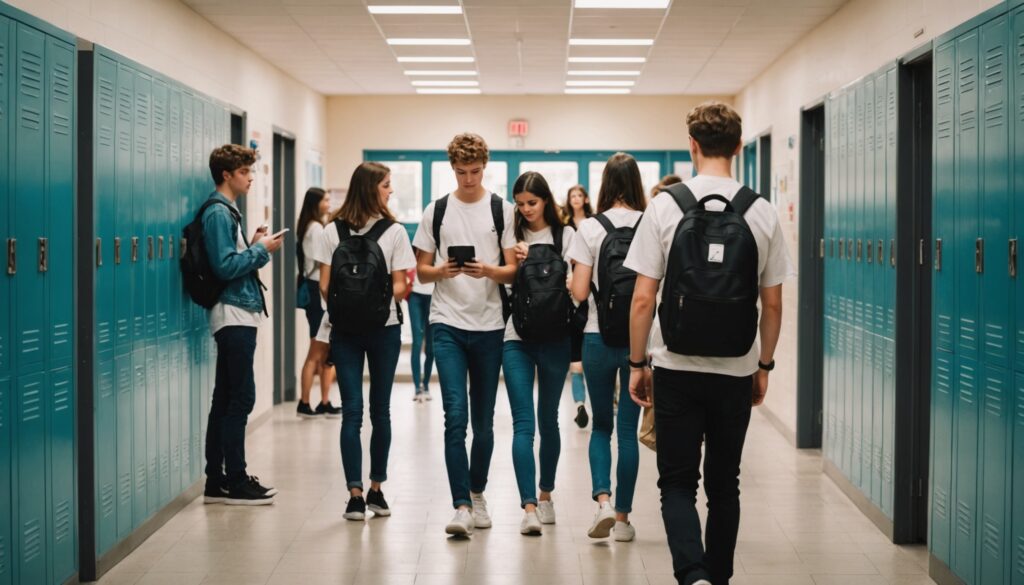
Education authorities point to two goals: preserving students' attention during class and fighting cyberbullying, a phenomenon that particularly affects teenagers on social media and messaging apps. For years, several teaching teams have reported that notifications and recreational smartphone use disrupt concentration, even outside strict class hours, in hallways or at the cafeteria.
The topic is part of a broader movement around the place of digital technology in minors' lives, which goes beyond the school issue alone: see our article on the right to digital erasure for minors in the face of generative artificial intelligence.
What This Changes for Students and Families
- The phone must remain off or put away for the entire time spent on school premises, according to each high school's own rules.
- The penalties for non-compliance fall under each school's local internal rules: temporary confiscation, a warning, or even disciplinary measures in case of repeat offenses.
- Educational uses supervised by a teacher remain possible, at the discretion of the teaching staff.
- Digital tools used in class by teachers are not affected by the measure: see our selection of digital tools used by teachers.
This measure is one of a series of back-to-school adjustments that directly affect families, in line with other programs overhauled this year such as the Pass Sport. As with other recent rules changing daily habits, such as the new regulation on the labeling of certain food products, it is once again up to those on the ground—here, schools—to translate a national guideline into concrete practice.
Frequently Asked Questions
Was the cell phone already banned in middle school?
Yes, the ban on cell phones on middle school grounds has been in effect since 2018. What's new this school year is its extension to high school, with each school required to specify its chosen arrangements in its internal rules.
Do all high schools apply the same rule?
No. The national framework requires a written, explicit rule to exist, but the concrete arrangements—total ban, drop-off lockers, tolerance outside of class—remain defined at each individual school's level.
What happens to a high school student who uses their phone in class despite the ban?
Penalties depend on the school's internal rules: temporary confiscation of the device, a warning, or even disciplinary measures in case of repeated violations.
Sources
info.gouv.fr — What changes in September 2026
Journal du Geek — Everything that changes in September 2026
Démarches Administratives — What changes in September 2026

Rupture Conventionnelle: Unemployment Benefit Duration Reduced Starting This Fall
The fall of 2026 brings a concrete financial change for tens of thousands of employees each year: starting September 1, 2026, the maximum duration of unemployment benefits after an individual rupture conventionnelle (a mutually agreed contract termination in France) decreases…

EHPAD: The New Decree That Forces Nursing Homes to Reveal the Truth About Staff
Choosing a nursing home (EHPAD, the French term for a long-term care facility for the elderly) for a loved one has long relied on vague criteria: the listed price, the atmosphere felt during a visit, word of mouth. A new…

Animal Welfare: The Government's Plan to Better Regulate Sales and Breeding
Selling dogs and cats in pet stores, animal fairs, exotic pets (NAC, “new companion animals”): the French government has unveiled an action plan aimed at closing the gaps still left by the 2021 law against animal abuse. Animal welfare is…

Suspension of the Pension Reform: What Changes for You
The suspension of the 2023 pension reform took effect on September 1 of this year in France. Passed as part of the Social Security financing law, it freezes the increase in the legal retirement age and the required contribution period…

August 1, 2026: What's Changing for Your Budget (Savings, Electricity, Back-to-School)
As at the start of every month, August 1, 2026 brings a series of changes that directly affect household budgets. Better-paying savings, a higher electricity bill, a slight dip in gas prices, and the payment of the back-to-school allowance: here…

VTC Drivers: The Exam Becomes Mandatory as the Government Closes the Equivalency Path
A new decree is reshuffling the rules of access to the profession of VTC (chauffeur-driven vehicle for hire) and VMDTR driver in France. Published on August 11, 2026, the text simply eliminates the so-called “equivalency path,” which until now allowed…

Pass Sport: Sports Club Enrollment Aid Drops but Opens to More Families
The Pass Sport is being renewed for the new season, but with a reduced amount: the aid drops from €70 to €50. In exchange, the program is being expanded to more families, with the return of children ages 6 to…
Cell Phones Banned in High School: What the New Law Says
It's official: starting this school year, the cell phone ban is extending to high schools. After nursery schools, elementary schools, and middle schools, it's now the turn of upper secondary institutions to shift to a framework where smartphones no longer…
This article was written with the help of artificial intelligence. Editorial policy